Why Developers Use Managed AI Services in 2026
2026-06-05

Managed AI services are specialized platforms that provide production-ready infrastructure and operational scaffolding for AI workloads, letting developers focus on building capabilities rather than maintaining complex deployment pipelines. The core reason why developers use managed AI services is straightforward: building and operating AI infrastructure from scratch consumes engineering resources at a scale most teams cannot justify. Platforms like those offered by Anthropic, OpenAI, and DigitalOcean have demonstrated that managed platforms collapse operational work from quarters to weeks. For any team where speed-to-market matters, that compression is the deciding factor.
Why developers use managed AI services instead of building their own
The standard industry term for this category is *managed AI infrastructure*, though "managed AI services" is equally common in practitioner discussions. Both refer to the same thing: a vendor-operated layer that handles provisioning, orchestration, monitoring, and governance of AI workloads so your team does not have to.
Building a custom AI stack is not just an infrastructure problem. It is a distributed systems problem. You need retries, credential management, tracing, and orchestration comparable to distributed systems at every layer. Most product teams do not have the bandwidth to build that correctly while also shipping features.
Here is what managed platforms handle out of the box, in order of operational impact:
- Rate limit management and circuit breakers. When a model provider throttles your requests, a managed service queues, retries, or falls back automatically. Without this, your application surfaces errors directly to users.
- State management and session persistence. Maintaining conversation context across requests requires careful storage design. Managed services abstract this entirely, including memory management for AI agents that need to recall prior interactions.
- Tracing and observability. Every prompt, model response, and latency measurement gets captured without custom instrumentation.
- Fallback logic. If a primary model is unavailable, traffic routes to a secondary model without developer intervention.
- Scaling. Compute scales with demand rather than requiring manual capacity planning.
The operational consequence is significant. Managed AI services reduce the need for five or more dedicated MLOps engineers focused solely on stability in multi-model environments. For a startup or a mid-size engineering team, that is the difference between shipping a product and maintaining infrastructure.
Pro Tip: *Start with a managed service when your team has fewer than ten engineers or when your time-to-market window is under three months. You can always migrate specific components to custom infrastructure once you understand your actual bottlenecks.*

What is the glue code problem in AI development?
Glue code is the wiring that connects compute, storage, networking, and authentication across disparate systems. In AI deployments, this wiring multiplies fast. You connect a model API, a vector database, an authentication layer, a logging service, a cost tracking tool, and a deployment pipeline. Each connection is a potential failure point.
Fewer integration points improve cost visibility and operational stability, and they enable granular expense tracking by agent, workflow, or user. That is not a minor convenience. When a production incident occurs at 2 AM, fewer seams mean fewer places to look.
| Dimension | DIY AI stack | Managed AI platform |
|---|---|---|
| Setup time | Weeks to months | Hours to days |
| Glue code volume | High: custom wiring for every service | Low: unified API surface |
| Failure points | One per integration (5 to 15+ typical) | Minimal: vendor-managed internally |
| Cost visibility | Requires custom tagging and tooling | Built-in per-agent and per-workflow tracking |
| Operational stability | Dependent on team expertise | SLA-backed with automated recovery |
| Debugging complexity | Distributed across multiple logs and systems | Centralized trace per request |
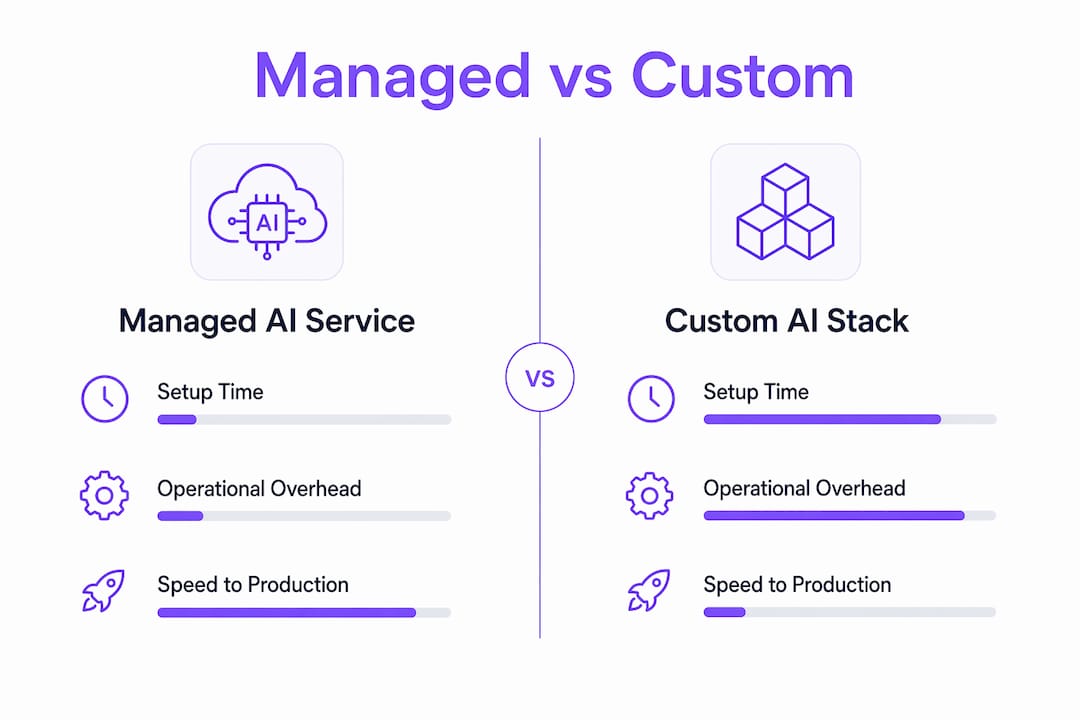
Unified AI platforms reduce seams developers must manage, which directly lowers integration complexity and allows smaller teams to scale AI applications effectively. DigitalOcean's integrated cloud approach is a practical example of this: by keeping compute, storage, and inference under one roof, teams avoid the authentication and latency overhead of stitching together three separate vendors.
Pro Tip: *Before adopting any managed platform, map every external service your AI system touches. If you count more than five distinct integrations, the glue code burden alone justifies a managed approach.*
How do managed AI services handle security and compliance?
Security and compliance in AI systems are not optional layers you add before launch. They are architectural decisions that, if deferred, require months of rework. Managed AI platforms embed these controls by default.
The specific features that matter most for regulated environments include:
- Role-based access control (RBAC). Developers, product managers, and auditors each get scoped permissions without custom identity logic.
- Audit logs. Every model call, configuration change, and data access event is recorded with timestamps and actor identity.
- Data residency controls. Data stays within specified geographic boundaries, which is non-negotiable for GDPR, HIPAA, and SOC 2 compliance.
- Encryption at rest and in transit. Managed platforms apply this by default rather than leaving it to per-service configuration.
- Shadow AI prevention. When AI tooling is centralized under a managed platform, teams cannot spin up unauthorized model integrations that bypass governance policies.
Governance and security defaults in managed platforms reduce months of compliance engineering by providing built-in encryption, audit logs, and identity controls. For a DIY stack, achieving the same posture requires custom engineering across every service in the chain. Managed AI services are critical not only for technical convenience but also for enterprise compliance and preventing shadow AI usage. That distinction matters when you are presenting architecture decisions to a security team or a customer's procurement department.
Managed AI services vs. custom-built AI infrastructure: which should you choose?
This is the question most tech leads face when AI moves from prototype to production. The answer depends on three variables: team size, compliance requirements, and how differentiated your AI infrastructure needs to be.
| Factor | Managed AI service | Custom-built stack |
|---|---|---|
| Time to production | Days to weeks | Months to quarters |
| Engineering cost | Vendor subscription | Salaries for 3 to 8+ engineers |
| Operational reliability | SLA-backed, automated | Team-dependent |
| Architectural flexibility | Constrained by vendor API | Full control |
| Vendor lock-in risk | High without exit planning | None |
| Compliance readiness | Built-in for most frameworks | Custom engineering required |
| Model switching | API-level change | Potential infrastructure rebuild |
Vendor lock-in and behavioral drift from managed AI service updates are real strategic risks. The mitigation is not to avoid managed services. It is to plan your exit strategy before you need it: abstract your model calls behind an internal interface, document your data formats, and monitor for API deprecations.
Most successful teams balance speed, reliability, and maintainability by starting with managed services and evolving custom solutions strategically. A common pattern is to use a managed platform for the first twelve months, identify the two or three components where custom control delivers measurable product differentiation, and migrate only those components. Everything else stays managed. You can explore vendor lock-in strategies in detail before committing to a platform to avoid costly migrations later.
How managed AI platforms accelerate product iteration
Production AI is not a one-time deployment. Models update, prompts need tuning, error patterns shift, and usage spikes unpredictably. Managed platforms are designed for this operational reality in ways that custom stacks rarely are at first.
The practical benefits that compound over time include:
- Built-in observability. AI-specific observability captures complete execution context including prompts, model responses, latencies, and downstream effect traces. This is hard to replicate in custom stacks and directly speeds up issue resolution.
- Model switching without infrastructure changes. Swapping from one model to another is an API parameter change, not an infrastructure rebuild. Teams can schedule AI-driven tasks and test new models in parallel without downtime.
- Cost guardrails. Managed AI services include cost controls preventing runaway consumption, with guardrails configurable by agent, workflow, or user. Unexpected invoices from a runaway agent are a real production risk that managed platforms address proactively.
- Faster debugging cycles. When a prompt produces unexpected output, centralized tracing shows exactly what the model received, what it returned, and how long each step took. Debugging a black box becomes debugging a labeled trace.
Reducing glue code burden is a competitive advantage. Teams that manage fewer seams deploy faster and incur lower operational risk. That advantage compounds with every product iteration: less time debugging infrastructure means more time shipping features that users actually see. For teams scaling AI agents across an enterprise, this velocity difference becomes a strategic gap within six to twelve months.
Key takeaways
Managed AI services reduce engineering overhead, accelerate deployment, and embed security controls that would otherwise require months of custom work to replicate.
| Point | Details |
|---|---|
| Deployment speed | Managed platforms compress time-to-production from quarters to weeks by bundling operational scaffolding. |
| Glue code reduction | Fewer integration points lower failure rates, improve cost visibility, and simplify debugging. |
| Security by default | Built-in RBAC, audit logs, and data residency controls eliminate months of compliance engineering. |
| Strategic trade-offs | Managed services favor speed and reliability; custom stacks favor flexibility. Plan your exit strategy early. |
| Iteration velocity | Centralized observability and model-switching capabilities let teams ship and tune faster than DIY infrastructure allows. |
What I've learned from watching teams choose managed AI infrastructure
I have watched teams make both choices, and the pattern is consistent. Teams that start custom do so because they believe their use case is unique enough to justify the overhead. Sometimes it is. More often, they spend the first six months building infrastructure that a managed platform already provides, then spend the next six months catching up on the product features they deferred.
The more interesting lesson is about governance. Most teams do not think about audit logs, data residency, or RBAC until a customer's security team asks for them during a procurement review. At that point, retrofitting these controls into a custom stack is painful. Managed platforms make governance table stakes from day one, which changes the conversation from "can we pass this audit" to "here is our compliance documentation."
My honest recommendation: treat managed AI infrastructure the way you treat a cloud provider. You would not build your own data center to ship a SaaS product. You should not build your own AI operational layer to ship an AI feature. The abstraction exists for good reason. Use it, understand its boundaries, and invest your engineering effort where it actually differentiates your product.
The one caveat I hold firmly is vendor lock-in. Abstract your model calls behind a thin internal interface from the start. It costs almost nothing upfront and gives you real optionality later. That single architectural decision separates teams that can migrate in a week from teams that face a six-month rewrite.
> *— Iosif Peterfi*
Deploy a managed AI agent without the infrastructure headache
If you are evaluating managed AI infrastructure options, Clawbase offers a concrete starting point. Clawbase provides managed OpenClaw hosting from $16/month, with one-click deployment on a dedicated server, 99.9% uptime, and access to over 50 AI models. No sysadmin expertise required.
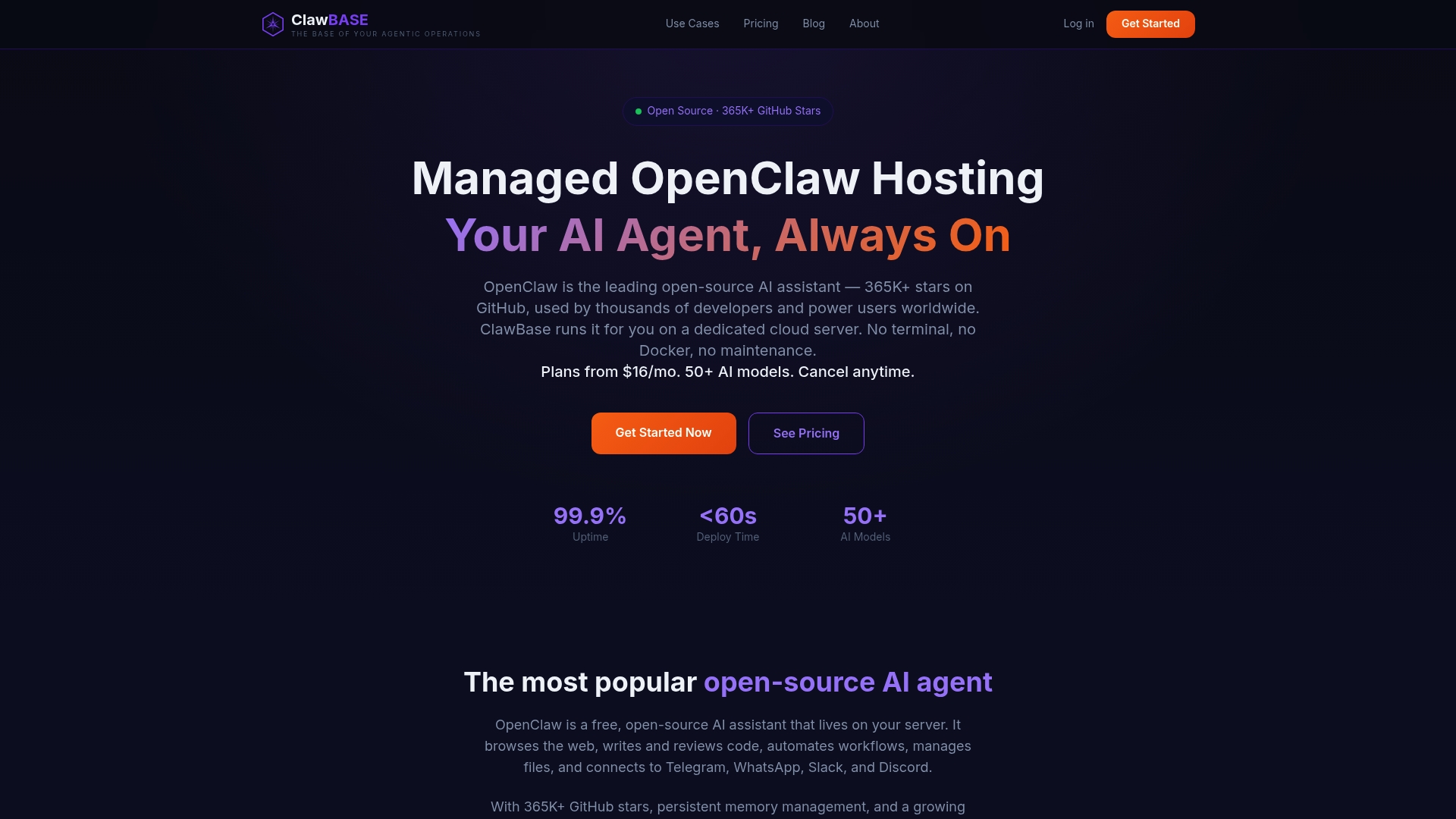
Clawbase handles the operational layer, including persistent memory management, security controls, and platform integrations with Telegram and Discord, so your team focuses on building rather than maintaining. You can review pricing tiers to match your deployment scale, or explore practical AI agent use cases to see what managed hosting enables in production.
FAQ
What is a managed AI service?
A managed AI service is a vendor-operated platform that handles the infrastructure, orchestration, monitoring, and governance of AI workloads. Developers interact with the AI capabilities through an API while the vendor manages retries, scaling, security, and observability.
Why do developers prefer managed AI over building custom stacks?
Managed platforms reduce time-to-production from months to days by providing built-in operational scaffolding. Teams avoid dedicating five or more engineers to infrastructure stability and instead focus engineering effort on product features.
What are the main risks of managed AI services?
Vendor lock-in and behavioral drift from platform updates are the primary risks. The standard mitigation is to abstract model calls behind an internal interface and document data formats before committing to a platform.
How do managed AI services handle compliance requirements?
Managed platforms embed role-based access control, audit logs, data residency controls, and encryption by default. These features typically require months of custom engineering in DIY stacks, making managed services the faster path to compliance readiness.
When should a team build custom AI infrastructure instead?
Custom infrastructure makes sense when your AI system requires architectural control that no managed platform provides, or when a specific component delivers measurable product differentiation. Most teams benefit from starting managed and migrating only the components where custom control is justified.