What Is AI Cost Optimization? A 2026 Finance Guide
2026-07-09

AI cost optimization is the practice of systematically reducing expenses related to AI model usage, infrastructure, and operational workflows while preserving or improving output quality and business outcomes. The industry term for this discipline is AI FinOps, a framework that attributes every dollar of AI spend to a specific business outcome. Structured governance strategies including model tiering, prompt caching, and batch processing achieve 40–70% inference cost reductions within 90 days. That number climbs to 80–90% when organizations stack multiple techniques together. For finance leaders and business decision-makers, understanding what is AI cost optimization means understanding where money leaks and how to stop it without slowing down the teams that generate value.
What are the primary cost drivers in AI systems?
AI spending concentrates in four areas: GPU compute, inference API calls, data pipeline processing, and operational overhead. Each behaves differently and requires a different control strategy.
GPU compute is the largest single cost for most organizations. Training runs are bursty by nature. They spike for days or weeks, then go quiet. Inference workloads are the opposite. They run continuously at a relatively steady rate. Training and inference require distinct procurement strategies, and conflating them leads to over-provisioning and waste. Buying reserved capacity for a training job that runs twice a year is the same mistake as renting a hotel room for a one-hour meeting.

Inference API calls follow token-based billing models. Every input token and every output token carries a price. Repetitive prompts, verbose system instructions, and unoptimized context windows all inflate token counts without adding value. The cost compounds fast at production scale.
Data pipelines add a less visible layer of expense. Embedding generation, vector database queries, retrieval-augmented generation pipelines, and preprocessing jobs all carry compute costs that rarely appear on a single line item. Finance teams often miss these because they live across multiple cloud services.
The table below maps each cost driver to its key characteristic and primary control lever:
| Cost driver | Characteristic | Primary control lever |
|---|---|---|
| GPU compute (training) | Bursty, short duration | Spot instances |
| GPU compute (inference) | Steady state, continuous | Commitment-based pricing |
| Inference API calls | Token-based billing | Prompt caching, model routing |
| Data pipelines | Distributed, multi-service | Usage attribution, batching |
| Operational overhead | Labor and tooling | Governance frameworks |
Key cost control actions by driver:
- Separate training budgets from inference budgets at the procurement level
- Tag every API call with a cost center and use case identifier
- Audit data pipeline jobs monthly for redundant embedding regeneration
- Monitor token consumption per workflow, not just per team
Which AI cost optimization strategies deliver the highest ROI?
The highest-return strategies combine immediate technical levers with longer-term governance practices. Neither alone is sufficient.
- Prompt caching and L1 result caching. Prompt caching combined with result caching can reduce token spending by 80–95% on repetitive workloads. The implementation cost is low and the payoff is immediate. Any workflow that sends similar or identical prompts repeatedly is a candidate.
- Batch API calls instead of synchronous calls. Switching to batch processing cuts costs approximately 50% compared to real-time API calls. Batch processing works well for document analysis, classification jobs, and any task where a user does not need a sub-second response.
- Model tiering and routing. Not every task needs a frontier model. Routing requests by complexity to the cheapest capable model reduces total AI spend by 50–80%. A simple classification task that costs $0.002 on a large model costs $0.0002 on a smaller one. At millions of calls per month, that gap is material.
- Dispatcher-First architecture. A Dispatcher-First architecture places a lightweight gatekeeper model in front of every expensive API call. The gatekeeper decides whether the request actually needs the expensive model or can be resolved with a cached result, a smaller model, or a rule-based response. This is the single highest-leverage architectural decision for cost reduction.
- Commitment-based GPU pricing and spot instances. Commitment-based pricing reduces steady-state inference costs by 40–72%. Spot instances for training workloads yield 60–90% savings. The tradeoff is flexibility, so apply commitments only to workloads with predictable, stable demand.
- Governance: spend attribution, shadow AI audits, and use-case rationalization. Combining architecture with governance produces durable savings. Shadow AI audits identify unauthorized or redundant AI tool subscriptions. Use-case rationalization asks whether each AI workflow actually generates measurable business value.
Pro Tip: *Start with prompt caching and batch API migration before touching infrastructure. Both deliver measurable savings within two weeks and require no changes to your model selection or cloud contracts.*
How do you balance cost optimization with AI quality and innovation?
Cost reduction without quality measurement is just cost cutting. The distinction matters enormously for business outcomes.
Aggressive cost caps kill innovation by suppressing experimentation and limiting the model access that teams need to test new capabilities. The goal is efficiency improvement, not fewer requests. A team that runs 10,000 well-structured API calls generating $500,000 in pipeline value is not a cost problem. A team running 10,000 poorly structured calls generating $5,000 in value is.
> "Over-optimization stifles innovation. Success metrics must include revenue growth and customer satisfaction alongside cost metrics. Effective optimization techniques improve speed and accuracy while dropping costs, without degrading service quality."
Techniques that reduce cost and improve quality simultaneously include:
- Shorter, cleaner prompts. Removing verbose instructions reduces token count and often improves model focus and output consistency.
- Structured output formats. Requesting JSON or structured responses reduces post-processing compute and error rates.
- Retrieval-augmented generation (RAG) with tight context windows. Feeding only the most relevant retrieved chunks keeps context lean and output accurate.
- Evaluation pipelines. Automated quality scoring on a sample of outputs catches degradation before it reaches users.
Cost optimization must be ongoing. Treating it as a recurring engineering lifecycle, rather than a one-time project, supports continual improvement and adaptability as models and pricing evolve.
Practical steps to implement AI cost optimization in your organization
Implementation follows a clear sequence: visibility first, governance second, architecture third.
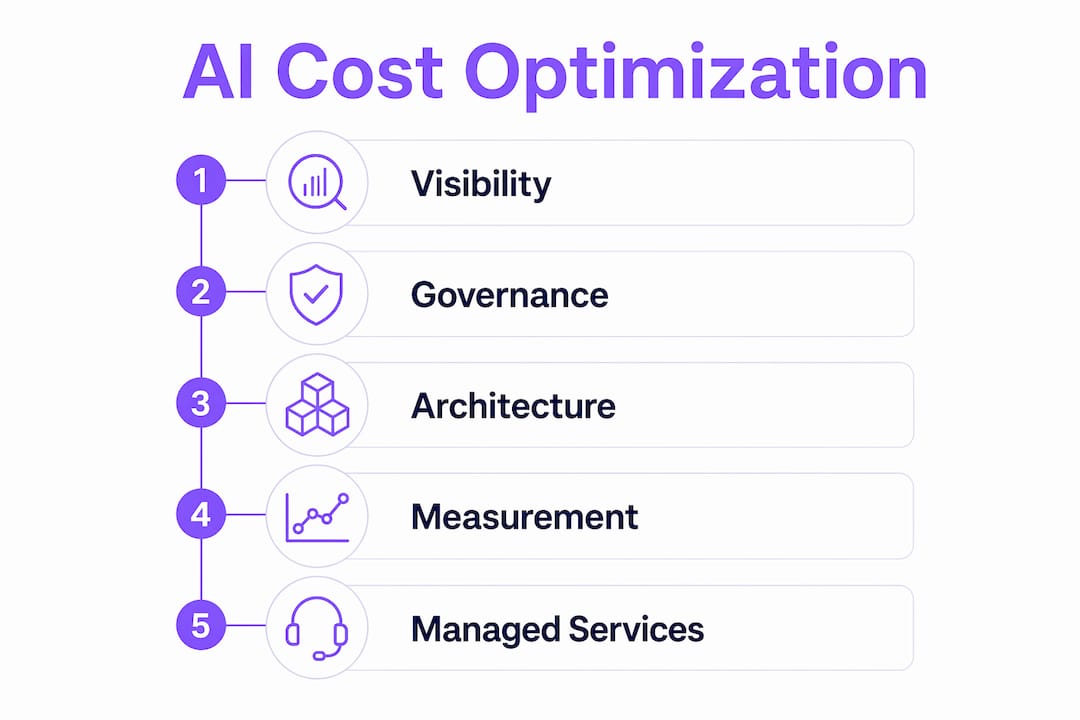
Step 1: Establish cost visibility. You cannot control what you cannot see. Integrate spend monitoring at the API call level, not just at the monthly invoice level. Tag every request with a team, use case, and business unit identifier. This single step reveals which workflows consume the most budget and which generate the least value.
Step 2: Set governance frameworks. Define spending thresholds by team and use case. Require business justification for any new AI tool or model tier above a defined cost per call. Run quarterly shadow AI audits to surface unauthorized subscriptions and redundant tools.
Step 3: Adjust engineering architecture. Implement a Dispatcher-First routing layer. Migrate eligible workflows to batch processing. Apply prompt caching to any workflow with repetitive inputs. These three changes address the majority of avoidable spend for most organizations.
Step 4: Measure cost against business outcomes. Attribute AI spend to the revenue, cost savings, or productivity gains it generates. A workflow that costs $10,000 per month and saves $200,000 in manual labor is a strong investment. One that costs $10,000 and saves $8,000 is not.
Pro Tip: *Many finance teams find that managed AI services eliminate a significant layer of infrastructure cost and operational complexity, particularly for teams without dedicated ML engineers.*
The table below compares two common implementation approaches:
| Approach | Best for | Cost control strength | Operational complexity |
|---|---|---|---|
| Self-managed cloud AI infrastructure | Large teams with ML engineers | High, if well-governed | High |
| Managed AI hosting | Small to mid-size teams | High, built-in controls | Low |
For teams assessing their readiness, the signs you need managed AI often include rising infrastructure costs with no clear attribution and engineering time spent on maintenance rather than product development.
Key Takeaways
AI cost optimization delivers 40–90% expense reductions when organizations combine technical levers like prompt caching and model routing with governance practices like spend attribution and shadow AI audits.
| Point | Details |
|---|---|
| Separate training from inference | Treat each workload type with its own procurement strategy to avoid over-provisioning. |
| Start with caching and batching | Prompt caching and batch API calls deliver 50–95% savings with low implementation effort. |
| Route by complexity | Model tiering reduces total AI spend by 50–80% by matching task complexity to model cost. |
| Govern with attribution | Tag every API call to a cost center and measure spend against business outcomes. |
| Treat optimization as ongoing | Cost governance is an engineering lifecycle, not a one-time project. |
Why most organizations get AI cost management wrong
Finance and engineering teams rarely share the same view of AI spend, and that gap is where most waste lives. I have seen organizations spend months negotiating cloud discounts while their developers ran unoptimized prompts that tripled token costs on every call. The discount saved 15%. The prompt fix would have saved 60%.
The deeper problem is that AI cost optimization gets treated as a finance initiative rather than an engineering discipline. Finance teams see the invoice. Engineering teams see the architecture. Neither group alone has the full picture. The organizations that make real progress are the ones that create a shared accountability model, where engineers own the technical levers and finance owns the outcome attribution.
The other mistake I see repeatedly is applying cost caps as the primary control mechanism. Caps are blunt instruments. They stop spending, but they also stop value creation. A team that hits a monthly cap in week two goes dark for the rest of the month. The right control is a routing and governance layer that makes expensive calls rare by design, not by prohibition.
Long-term, the organizations that treat AI FinOps as a continuous engineering practice, not a quarterly budget review, are the ones that sustain savings without sacrificing the experimentation that drives product improvement. The open-source AI scalability challenges that emerge at scale make this discipline even more critical as AI usage grows.
> *— Iosif Peterfi*
Clawbase managed hosting for AI cost control
Clawbase offers a direct path to lower AI infrastructure costs without the engineering overhead of self-managed deployments.
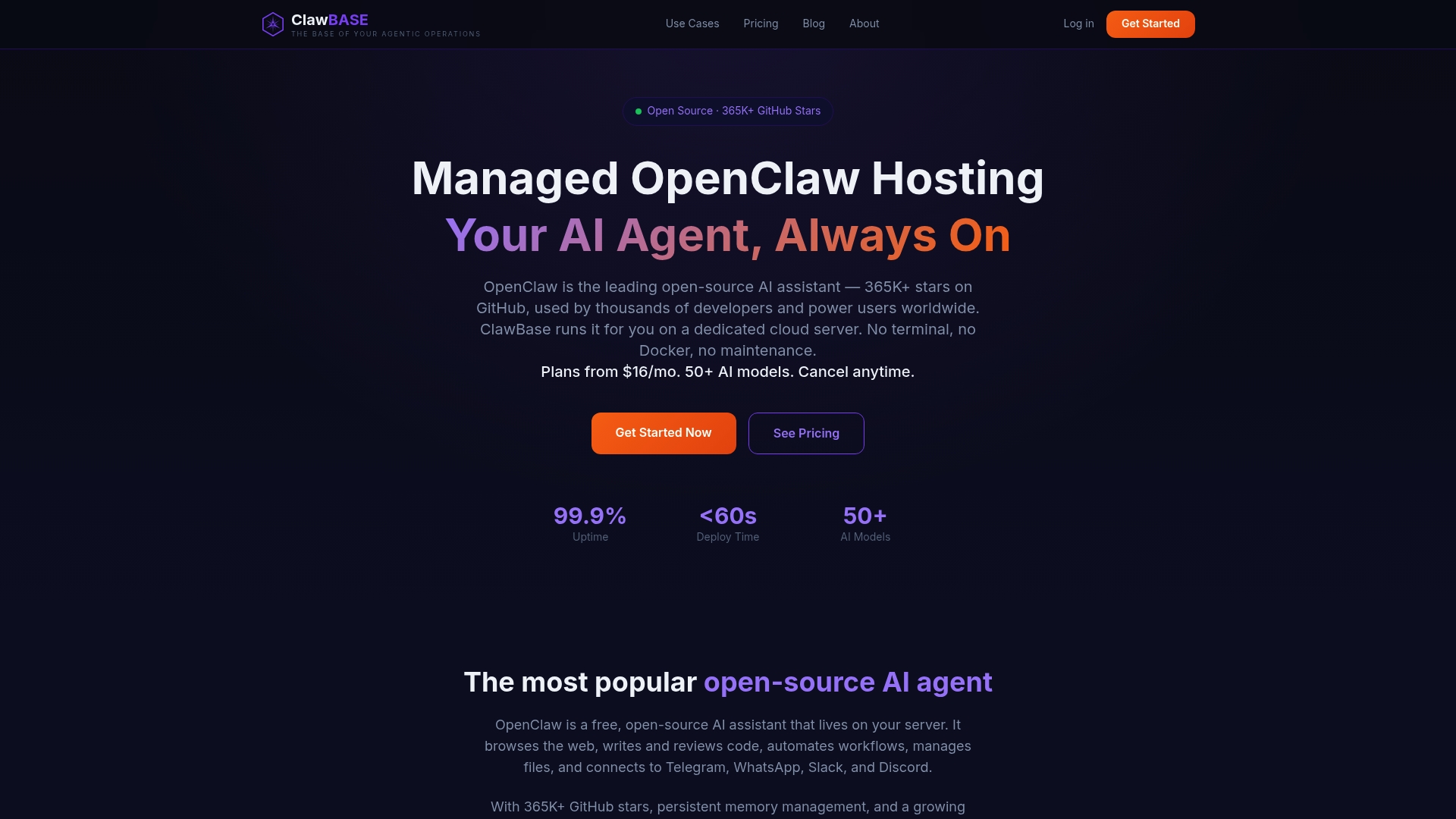
Managed OpenClaw hosting starts at $16 per month and includes one-click deployment on a dedicated server, 99.9% uptime, persistent memory management, and access to over 50 AI models. For finance and operations teams, that means predictable monthly costs with no surprise compute bills. For engineering teams, it means no server maintenance pulling focus from product work. The real-world AI agent use cases on the Clawbase platform show how organizations apply these capabilities to workflow automation, file management, and communication integrations across Telegram and Discord. If your team is spending more time managing AI infrastructure than using it, Clawbase is worth a close look.
FAQ
What is AI cost optimization?
AI cost optimization is the practice of reducing AI operational expenses, including GPU compute, API calls, and data pipelines, while maintaining or improving output quality and business value. The discipline combines technical levers with governance frameworks under the AI FinOps model.
How much can organizations save with AI cost optimization?
Structured optimization strategies achieve 40–70% inference cost reductions within 90 days. Stacking advanced techniques like prompt caching, model routing, and commitment-based pricing pushes savings to 80–90%.
What is the fastest way to reduce AI API costs?
Switching to batch API calls cuts costs approximately 50%, and prompt caching reduces input token spending by 10–95% depending on workload repetitiveness. Both changes can be implemented within days.
Does cost optimization hurt AI performance?
Poorly designed cost cuts do hurt performance. Effective optimization techniques, including cleaner prompts, structured outputs, and model routing, improve speed and accuracy while reducing costs. The key is measuring quality metrics alongside cost metrics throughout the process.
What is a Dispatcher-First architecture?
A Dispatcher-First architecture routes every incoming request through a lightweight gatekeeper model before sending it to an expensive frontier model. The gatekeeper resolves simple requests with cached results or smaller models, preventing unnecessary high-cost API calls.