What Is Adaptive Learning with AI? A 2026 Guide
2026-07-15

Adaptive learning with AI is defined as an instructional approach where artificial intelligence algorithms continuously assess each learner's performance and automatically adjust content, pacing, and pathways to match individual needs. Unlike static courses that deliver the same material to everyone, AI-driven adaptive learning systems build a live model of what each learner knows and does not know, then route them accordingly. Pathway Personalization and Evaluation Evidence together account for 46% of current research focus in this field. That concentration signals where the real educational value lies: not in delivering more content, but in delivering the *right* content at the right moment.
What is adaptive learning with AI, and how does it work?
Adaptive learning technology operates through three core components: a data collection layer, a learner model, and a decision engine. Each component does a distinct job, and the system only works when all three function together.
- Data collection. The system continuously collects learner behavior including response accuracy, time spent per question, number of attempts, and error patterns. This is not passive logging. Every interaction updates the system's picture of the learner.
- Learner modeling. The collected data feeds a dynamic knowledge model. The system distinguishes between a learner who answered correctly after three attempts and one who answered correctly on the first try. Those two learners are not in the same place, and the model reflects that difference.
- Decision engine. The engine uses the learner model to route content. A learner who has mastered a concept skips redundant review. A learner who is struggling gets targeted remediation rather than generic repetition. Advanced systems use Concept Graphs to map semantic dependencies between topics, so remediation targets the actual knowledge gap rather than the surface symptom.
This is what separates genuine adaptive learning from self-paced learning or simple content recommendation. Self-paced learning lets you move faster or slower. Content recommendation suggests what to read next. Adaptive learning with AI changes *what* you learn, *how deeply* you practice it, and *in what order* you encounter it, all based on real-time evidence.
Pro Tip: *When evaluating any adaptive learning platform, ask specifically whether its decision engine uses a learner model or just a content recommendation algorithm. The difference determines whether the system truly adapts or just suggests.*

What pedagogical theories support AI-driven adaptive learning?
A well-designed adaptive system does not run on algorithms alone. The strongest systems are grounded in established learning theory. AI enhances education by operationalizing proven pedagogical principles, not by replacing them with pure computational efficiency.
The main theories that inform effective adaptive learning design include:
- Constructivism. Learners build knowledge by connecting new information to what they already understand. Adaptive systems operationalize this by sequencing content so each new concept builds on confirmed prior knowledge rather than assumed prior knowledge.
- Self-regulated learning. Learners who monitor their own progress and adjust their strategies perform better. Adaptive systems support this by surfacing performance data to learners, not just to instructors.
- Differentiated instruction. Not every learner needs the same depth of explanation or the same number of practice repetitions. Adaptive systems automate differentiation at a scale no single teacher can manually manage.
- Connectivism. In networked learning environments, knowledge exists across people, tools, and systems. Adaptive AI platforms fit naturally into this model by connecting learner data, content repositories, and instructor dashboards into one feedback loop.
The critical point is alignment. A system that adapts pathways without grounding those decisions in sound pedagogy is just an algorithm optimizing for completion rates. Expert evaluations rate theory-driven adaptive frameworks with a mean suitability score of 3.18 out of 4.00, reflecting genuine confidence in pedagogically grounded designs. That score matters because it comes from educators, not engineers.
What are the benefits and challenges of adaptive learning with AI?
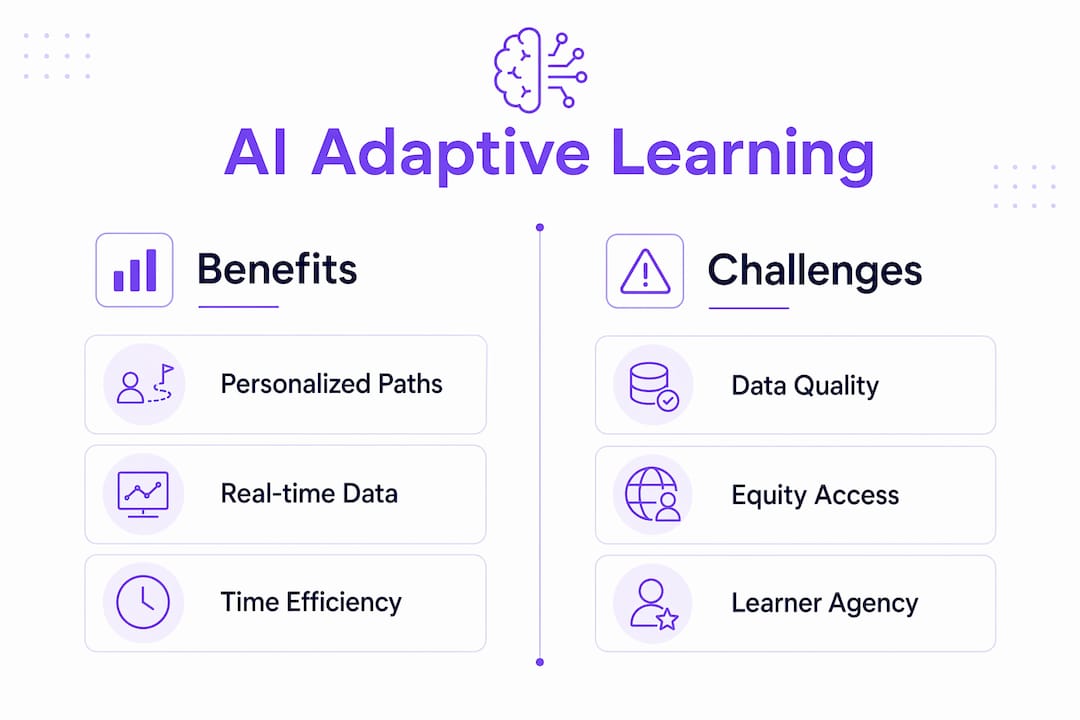
The benefits of adaptive learning with AI are real, but they come with conditions. Understanding both sides helps educators and learners make better decisions about adoption.
Core benefits
Personalized pathways reduce wasted time. A learner who already understands fractions does not need to sit through a fractions module. A learner who struggles with inference in reading gets more practice there, not in vocabulary where they are already strong. This efficiency compounds over time, producing faster skill acquisition and better long-term retention.
AI also gives instructors something they rarely have: granular, real-time data on every learner's knowledge state. That data enables targeted interventions rather than reactive ones. Instead of waiting for a failed test to identify a gap, an instructor can act on the system's signals days earlier.
Key challenges
High-quality, granular data is the foundation of accurate adaptation. When data is sparse or low-quality, the system cannot distinguish genuine mastery from lucky guessing. Poor data produces poor learning paths, and poor learning paths erode trust in the system.
Equity is a structural challenge. Adaptive learning platforms require reliable internet access, capable devices, and institutional infrastructure. Learners without these resources cannot benefit equally, which risks widening existing educational gaps rather than closing them.
Learner agency is the subtler risk. Over-automation creates dependency when learners follow AI-generated paths without reflecting on their own learning process. A system that does all the routing for you can actually reduce metacognitive development if it is not designed to prompt self-reflection alongside its recommendations.
Pro Tip: *Build in regular "pause and reflect" prompts within any adaptive learning program. Asking learners to predict their own performance before seeing results activates metacognition and reduces passive dependency on the system's routing.*
How can educators and learners use adaptive learning effectively?
Knowing the theory is one thing. Putting it into practice requires deliberate choices about platform selection, teacher roles, and learner engagement. Here is what actually works.
- Evaluate platforms on their learner model depth. Ask vendors whether the system tracks individual concept mastery or just module completion. Concept-level tracking produces far more useful adaptation than course-level tracking.
- Use AI to free up teacher time for high-value work. AI augments teachers most effectively when it handles repetitive tasks like progress monitoring and content routing, leaving instructors free for mentoring, discussion facilitation, and complex problem-solving support.
- Treat the reporting dashboard as a teaching tool. Granular learner data is only useful if instructors act on it. Schedule regular reviews of concept-level performance data and use it to plan small-group interventions.
- Encourage learners to engage with their own data. Show learners their knowledge maps and progress trends. Learners who understand where they are strong and where they are weak make better study decisions. This is self-regulated learning in practice.
- Balance automation with human oversight. No adaptive system should run without a teacher in the loop. The system identifies patterns; the teacher interprets context. A learner who is struggling may need emotional support, not just a different content sequence.
If you are a learner rather than an instructor, the same principles apply at the individual level. Actively check your performance data, set your own learning goals alongside the system's recommendations, and use tools like AI-powered subject learning to complement structured adaptive programs with open-ended exploration. The learners who get the most from adaptive systems are the ones who stay curious and reflective, not the ones who just follow the queue.
Understanding the role of personal AI tutors alongside adaptive platforms also helps. Tutors handle conversational, open-ended learning. Adaptive systems handle structured skill progression. Together, they cover more ground than either does alone.
Key Takeaways
Adaptive learning with AI works best when strong learner modeling, sound pedagogy, and active human oversight operate together rather than in isolation.
| Point | Details |
|---|---|
| Core mechanism | AI collects behavior data, builds a learner model, and routes content through a decision engine. |
| Pedagogical grounding | Effective systems apply constructivism and self-regulated learning, not just algorithmic efficiency. |
| Data quality matters | Sparse or low-quality data produces inaccurate learning paths and undermines personalization. |
| Teacher role is central | AI augments instructors by automating routine tasks, freeing them for high-value teaching. |
| Learner agency is non-negotiable | Systems must prompt metacognition to avoid passive dependency on AI-generated pathways. |
The part most people skip when adopting adaptive learning
I have watched institutions roll out adaptive learning platforms with genuine enthusiasm, then quietly shelve them within two years. The technology was not the problem. The implementation was.
The pattern repeats: a platform gets selected based on a demo, teachers receive a one-hour orientation, and learners are expected to engage with a system they do not understand. When results disappoint, the conclusion is that adaptive learning does not work. The real conclusion is that evidence-based adoption requires more than a subscription.
What I have found actually works is treating the adaptive system as infrastructure, not a solution. The system creates conditions for better learning. Teachers and learners still have to do the work. Institutions that invest in teacher training, that review learner data regularly, and that build in structured reflection time see measurably different outcomes than those that treat the platform as a set-and-forget tool.
The equity dimension also deserves more honest attention than it typically gets. Adaptive learning amplifies what learners bring to it. A learner with strong foundational skills and reliable internet access will benefit enormously. A learner with gaps in prior knowledge and inconsistent access will fall further behind if the system is not carefully monitored. Technology does not automatically level the playing field. It can widen gaps just as easily as it closes them.
My honest position: adaptive learning with AI is one of the most promising developments in education I have seen. But promising is not the same as automatic. The institutions that will benefit most are the ones that approach it with rigor, patience, and a genuine commitment to the learners who need it most.
> *— Iosif Peterfi*
How Clawbase supports AI-powered learning workflows
Adaptive learning systems depend on AI agents that run reliably, process data continuously, and integrate with the tools educators already use. Clawbase makes that infrastructure accessible without requiring a dedicated IT team.
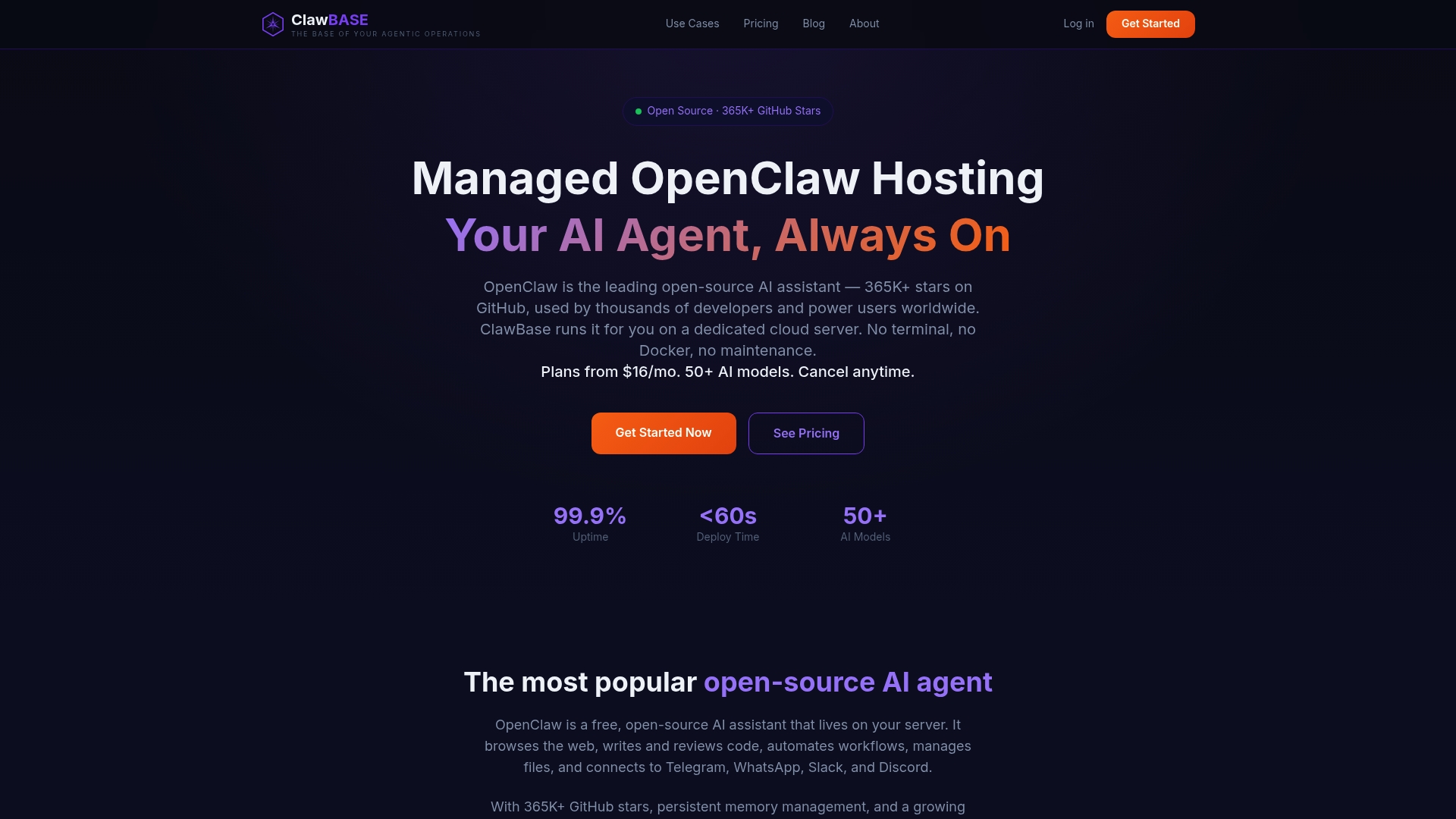
Clawbase deploys OpenClaw, a powerful open-source AI assistant, with one-click setup on a dedicated server. It runs with 99.9% uptime, persistent memory management, and access to over 50 AI models. Educators and developers can connect it to communication platforms like Telegram and Discord, automate administrative workflows, and build custom AI agents that support personalized learning at scale. Explore the full range of AI agent use cases to see how Clawbase fits into adaptive learning environments, or go directly to Clawbase managed hosting starting at $16/month to get started without the technical overhead.
FAQ
What is adaptive learning with AI in simple terms?
Adaptive learning with AI is an educational approach where software continuously tracks how a learner performs and automatically adjusts the content, difficulty, and sequence to match that individual's current knowledge state.
How does adaptive learning differ from self-paced learning?
Self-paced learning lets learners control their speed through fixed content. Adaptive learning with AI changes the actual content and sequence based on demonstrated mastery, not just the pace.
What data does an adaptive learning system collect?
Adaptive systems track response accuracy, time spent, number of attempts, and error patterns to build a dynamic model of each learner's knowledge state.
Can adaptive learning replace teachers?
No. Studies show that AI produces better learning outcomes when it supplements teachers rather than replaces them. The system handles data routing; teachers handle context, mentoring, and motivation.
What is the biggest risk of adaptive learning with AI?
The biggest risk is over-automation. When learners follow AI-generated paths without reflecting on their own progress, dependency replaces metacognition, and genuine knowledge transfer suffers.