Types of AI Learning Tools in 2026: A Full Guide
2026-07-12

AI learning tools are defined as software systems that use machine learning, natural language processing, or generative AI to support education, skill development, and knowledge retention. The types of AI learning tools 2026 has produced fall into five clear categories: personalized tutoring assistants, spaced repetition and flashcard generators, research and summarization tools, writing assistants, and task organizers. 85% of students now use AI for coursework support including brainstorming and studying. That number signals a fundamental shift in how educators, students, and professionals approach learning. Pricing across these tools ranges from free tiers to $20/month, making AI-assisted education more accessible than ever before.
1. What are AI-powered personalized tutoring tools?
AI tutoring tools are the most widely requested category of AI education tools in 2026. 60% of students identify personalized tutoring and concept explanation as AI's primary value. That preference drives the design of tools built around Socratic questioning, stepwise hints, and interactive explanation rather than direct answer delivery.
The best tutoring tools adapt to a learner's demonstrated mastery level. They track which concepts a student struggles with and adjust the difficulty of follow-up questions accordingly. This metacognitive scaffolding approach builds critical thinking rather than shortcutting it.

Advanced tutoring platforms now use multi-agent pipelines that separate safety, pedagogy, and evaluation into distinct AI agents. Each agent handles a specific function, which increases reliability and reduces the risk of a language model producing misleading explanations. This architecture is especially important for STEM subjects where precision matters.
Key features to look for in AI tutoring tools:
- Socratic questioning mode that guides rather than answers
- Mastery tracking across sessions with persistent memory
- Curriculum alignment so the tool stays relevant to your course
- Multi-agent safety layers for factual accuracy
- Subscription tiers from free to $20/month
Pro Tip: *Use AI tutoring tools for concept exploration, then bring specific questions to your human instructor. The combination produces better understanding than either approach alone.*
You can read more about how this category works in practice in this personal AI tutor guide from Clawbase.
2. How do AI flashcard and spaced repetition tools improve retention?
Spaced repetition is the most evidence-backed memorization method in cognitive science. AI tools automate the scheduling logic, presenting cards at the exact intervals that maximize long-term retention before forgetting occurs. Longitudinal evidence confirms that spaced repetition outperforms quick AI summaries for durable learning.
Quick AI summaries create an illusion of competence. A student reads a clean summary and feels they understand the material, but that feeling fades fast without active recall practice. Spaced repetition forces retrieval, which is the mechanism that actually strengthens memory.
Modern AI flashcard tools go beyond manual card creation. They generate cards automatically from uploaded PDFs, lecture notes, or recorded audio. The AI identifies key terms, definitions, and relationships, then formats them into testable question-and-answer pairs.
Here is how the generation and review cycle works in most AI flashcard tools:
- Upload your source material (PDF, notes, or audio transcript)
- AI extracts key concepts and generates flashcard pairs
- The algorithm schedules your first review session
- You rate your recall confidence after each card
- The system adjusts future review timing based on your rating
- Difficult cards appear more frequently; mastered cards appear less often
> Spaced repetition tools like Anki provide superior long-term retention despite a steep learning curve, outperforming quick AI summaries for durable knowledge. The science behind this is active recall: retrieving information from memory strengthens the neural pathways that store it.
Free tiers on most AI flashcard platforms support basic card creation and review. Paid plans, typically $7.99–$8.33/month, unlock AI-generated card sets, auto-graded tests, and advanced scheduling algorithms.
3. What role do AI research and summarization tools play in study habits?
AI research tools built on Retrieval-Augmented Generation, commonly called RAG, represent a significant technical advance over generic chatbots. RAG anchors AI output in user-uploaded course materials, which prevents the hallucinations that ungrounded language models produce. The practical result is a tool that answers questions about your specific textbook, lecture slides, or research papers rather than inventing plausible-sounding but incorrect information.
Students use these tools to synthesize large reading loads quickly. A 40-page journal article can be summarized into key arguments in seconds. The AI then answers follow-up questions grounded in that specific document, not in general training data.
AI tools grounded in course materials consistently outperform generic chatbots in academic contexts. Students want AI that adapts to their mastery and stays relevant to their actual coursework. RAG-based tools deliver exactly that.
| Feature | Basic summarization tools | RAG-based research tools |
|---|---|---|
| Source grounding | No | Yes |
| Hallucination risk | High | Low |
| Q&A on your documents | No | Yes |
| Audio/video overview | Sometimes | Yes |
| Pricing | Free | $8–$20/month |
Pro Tip: *After using a RAG-based research tool to summarize a chapter, export the key claims as flashcard prompts. Feed them into your spaced repetition app. This two-tool workflow covers both comprehension and retention.*
4. How do AI writing assistants and task organizers boost productivity?
AI writing assistants address one of the most time-consuming parts of academic and professional work: drafting and revising text. Writing assistants like Grammarly provide AI-powered grading aligned to rubrics and plagiarism detection alongside standard grammar feedback. That combination makes them useful for both students submitting essays and educators grading them.
Task organizer tools serve a different but equally important function. They break complex study goals into specific, sequenced steps. This is particularly valuable for neurodivergent learners who struggle with executive function, since the AI handles the planning layer and leaves the learner free to focus on the actual work.
Text-to-speech and AI summary tools extend accessibility further. Auditory learners can convert dense reading material into spoken audio, which improves comprehension and reduces reading fatigue. These tools often integrate with research summarizers to create a full audio overview of uploaded documents.
Key capabilities in this category:
- Rubric-aligned feedback on drafts before submission
- Plagiarism detection with source identification
- Task decomposition for complex projects
- Text-to-speech conversion for auditory learners
- Integration with calendar and project management apps
AI tools that support writing with structured feedback are favored over tools that simply complete tasks for the student. The distinction matters: feedback builds skill, while task completion builds dependency.
5. Which AI learning tool types fit different educational scenarios?
Matching the right AI tool category to your learning context produces better outcomes than using a single general-purpose tool for everything. The table below maps common educational scenarios to the most effective AI tool type.
| Learning scenario | Best AI tool category | Reason |
|---|---|---|
| Memorization-heavy courses (medicine, law, languages) | Spaced repetition and flashcard tools | Active recall builds durable retention |
| Reading-intensive subjects (history, literature, policy) | RAG-based research and summarization tools | Grounds answers in your actual texts |
| STEM and concept-heavy courses | AI personalized tutoring tools | Stepwise guidance builds problem-solving skills |
| Essay-heavy courses | AI writing assistants | Rubric-aligned feedback improves drafts |
| Complex projects with many moving parts | AI task organizers | Breaks goals into manageable steps |
Free tool stacks work well for students on tight budgets. Combining a free spaced repetition app with a free-tier RAG summarizer covers the two highest-impact use cases without any cost. Paid plans in the $8–$20/month range add depth, unlimited usage, and integration features that matter more for professionals and educators than for casual learners.
For a practical walkthrough of combining these categories effectively, the Clawbase guide on learning a new subject fast lays out a concrete multi-tool approach.
Key takeaways
The most effective AI learning strategy in 2026 combines RAG-based research tools, spaced repetition apps, and AI tutoring systems rather than relying on any single platform.
| Point | Details |
|---|---|
| Five core tool categories | Tutoring, flashcard/spaced repetition, research/RAG, writing assistants, and task organizers each serve distinct learning needs. |
| RAG reduces hallucinations | Tools grounded in your uploaded materials produce more accurate answers than generic chatbots. |
| Spaced repetition beats summaries | Active recall through scheduled review builds durable memory; quick summaries create an illusion of competence. |
| Pricing is accessible | Most AI learning tools offer free tiers, with paid plans ranging from $7.99 to $20/month. |
| Match tool to scenario | Memorization courses need flashcard tools; STEM courses need tutoring tools; essay courses need writing assistants. |
What I've learned from watching AI learning tools mature
The conversation around AI in education tends to split into two camps: enthusiastic adoption and fearful rejection. Neither position is useful. What I've observed after testing and analyzing these tools across real educational contexts is more nuanced and, frankly, more interesting.
The tools that actually improve learning outcomes share one characteristic: they make the student do the cognitive work. A tutoring tool that asks "What do you think happens next?" is more valuable than one that explains the answer unprompted. A flashcard app that forces retrieval is more valuable than a summary that delivers information passively. The risk of overreliance is real. When AI handles the thinking, students lose practice in metacognitive monitoring, which is the skill of knowing what you know and what you don't.
The educators I find most credible are the ones who treat AI tools as infrastructure, not as teachers. They design courses where AI handles the repetitive scaffolding work, like drilling vocabulary or summarizing background reading, while class time focuses on discussion, application, and judgment. That division of labor is where AI actually adds value without undermining the learning process.
My honest concern is that most students pick tools based on convenience rather than effectiveness. A tool that generates a clean summary in 10 seconds feels productive. A spaced repetition session that makes you struggle to recall a term feels slow and frustrating. The frustrating one is doing the real work. I'd push any serious learner to prioritize the tools that feel harder to use, because that friction is usually the learning happening.
The multi-agent architecture trend in AI tutoring is the development I'm watching most closely. Separating safety, pedagogy, and evaluation into distinct agents is the right technical direction. It makes tutoring systems more reliable and more honest about what they don't know. That honesty is what education actually needs from AI.
> *— Iosif Peterfi*
Clawbase and managed AI for educational deployments
Educators and developers building custom AI learning tools face a real infrastructure problem. Deploying a private AI agent that maintains persistent memory, integrates with communication platforms, and stays online reliably requires significant server management expertise.
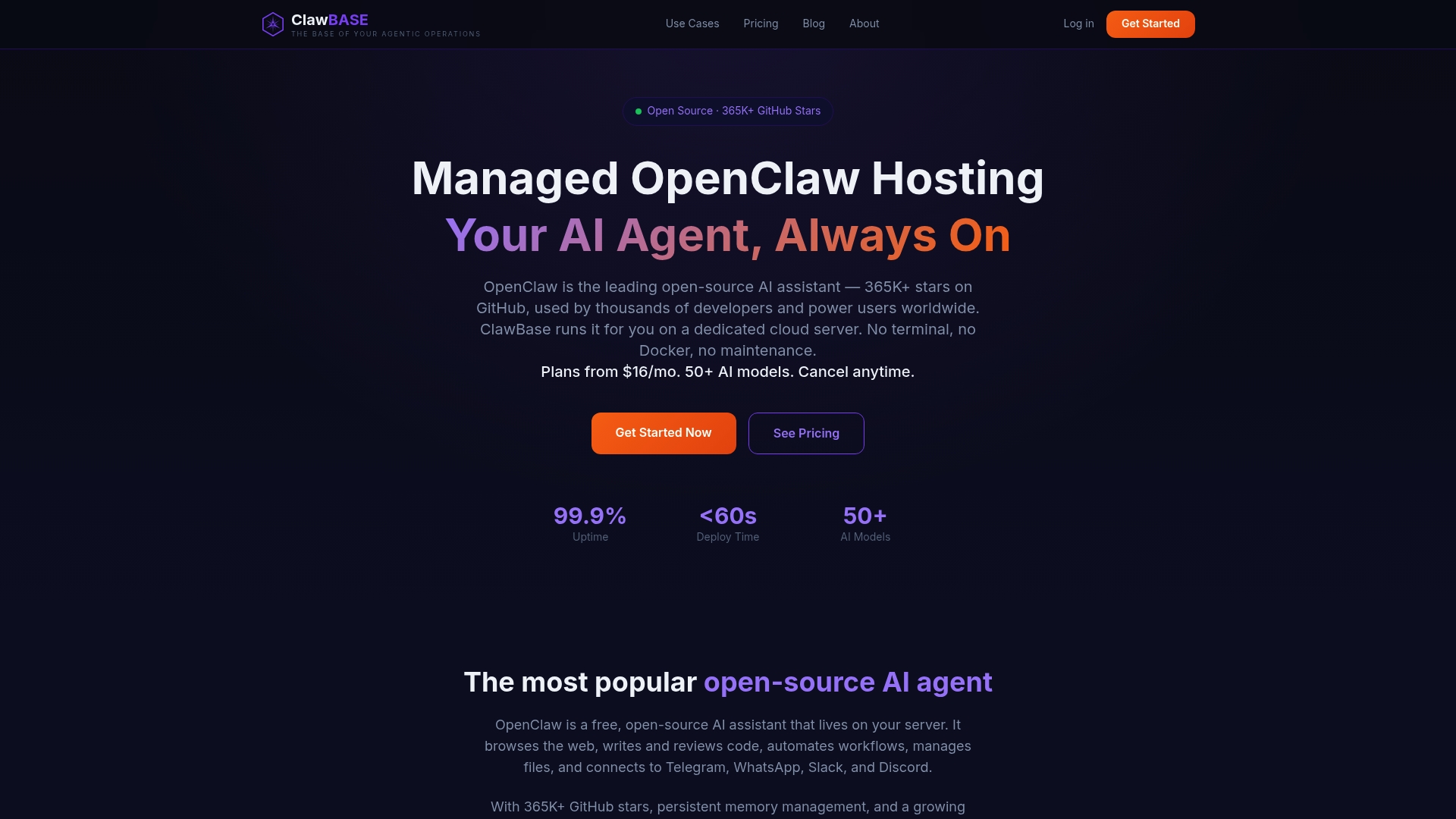
Clawbase solves that problem with managed OpenClaw hosting starting at $16/month. One-click deployment puts a private, always-on AI agent online without any sysadmin work. The agent supports over 50 AI models, maintains persistent memory across sessions, and integrates with Telegram and Discord. For educators building personalized tutoring agents or professionals deploying AI study assistants, Clawbase provides the infrastructure layer without the technical overhead. You can review the full range of educational AI agent use cases to see how these deployments work in practice.
FAQ
What are the main types of AI learning tools in 2026?
The five main categories are AI tutoring assistants, spaced repetition and flashcard tools, RAG-based research and summarization tools, AI writing assistants, and task organizer tools. Each category targets a different part of the learning process.
Why do students use AI learning tools instead of traditional study methods?
85% of students use AI for coursework support because these tools provide personalized, on-demand feedback that traditional textbooks and static resources cannot match.
What is RAG and why does it matter for AI study tools?
Retrieval-Augmented Generation (RAG) grounds AI responses in your uploaded course materials rather than general training data. This reduces hallucinations and makes the tool's answers relevant to your specific subject matter.
How much do AI learning tools cost in 2026?
Most AI learning tools offer free tiers for basic features. Paid plans range from $7.99 to $20/month depending on usage limits, AI model access, and advanced features like unlimited tutoring or deep research modes.
What is the biggest risk of using AI learning tools?
Psychology research identifies overreliance as the primary risk. When AI completes cognitive tasks for the learner, metacognitive skills weaken and long-term retention suffers. Tools that scaffold thinking rather than replace it produce better educational outcomes.