Professional AI Automation Mistakes to Avoid in 2026
2026-07-19

Professional AI automation mistakes are primarily failures of process governance and human oversight, not failures of the underlying AI model. Teams that rush to automate without documenting workflows, scoping access, or building monitoring into their systems create fragile pipelines that break quietly and expensively. The consequences range from silent data corruption to catastrophic production incidents. Understanding where these AI implementation challenges originate is the first step toward building automation that actually holds up under real workloads.
1. Professional AI automation mistakes start with broken workflows
The most common AI automation error is automating a process that was never properly defined in the first place. AI automation failure patterns are mostly process governance problems, not model optimization issues. That distinction matters because teams often spend weeks tuning prompts when the real problem is an undocumented, ownerless workflow underneath.
Tribal knowledge is the silent killer here. When a process lives in one person's head, automating it just scales the confusion. The AI will faithfully reproduce every inconsistency, exception, and undocumented edge case that the original human operator handled by instinct.
Before you automate anything, answer these questions:
- Who owns this process end to end?
- Is every decision point documented and testable?
- What happens when an exception occurs?
- Does the process produce a consistent, measurable output?
If you cannot answer all four, the workflow is not ready for automation.
> "Automation success depends on ownership, governance, exception handling, and redefining workflows — not just on tuning AI models. Business outcome focus rather than model tuning drives more reliable automation."
This is the process-first principle. Reducing manual work with AI agents only pays off when the underlying process is clean, owned, and documented before the AI touches it.
2. Granting AI unchecked production-level access

Giving an AI agent broad write access to production systems is one of the most dangerous professional AI deployment mistakes a team can make. One documented incident involved giving an AI agent full production access, which resulted in the loss of three months of customer data in a single unreviewed operation. That is not a model failure. That is an access control failure.
The minimum access principle applies here with full force. An AI agent should hold only the permissions it needs for the specific task it is running, scoped to the narrowest possible resource set. Destructive operations such as deletes, overwrites, and schema changes should be treated as human-only actions. The AI can prepare the operation and stage it for review, but a human must confirm before execution.
| Access Type | AI Permission | Human Required |
|---|---|---|
| Read data | Allowed | No |
| Write new records | Allowed with logging | No |
| Update existing records | Allowed with audit trail | Recommended |
| Delete records | Staged only | Yes, always |
| Schema or config changes | Staged only | Yes, always |
Safety controls like scoped credentials and infrastructure-level hard gates are not optional extras. They are the foundation of any responsible AI workflow in production.
Pro Tip: *Set up a separate service account for each AI agent with permissions scoped to the exact tables and actions it needs. Rotate credentials on a schedule and log every write operation to a tamper-resistant audit trail.*
3. Architecture failures that cause AI automation to break at scale
Most AI automation works fine in testing and breaks in production. The reason is almost never the model. It is the infrastructure around the model. Infrastructure gaps such as brittle triggers and missing anomaly detection lead to silent failures that automated error logging never catches.
Six architectural failure modes appear repeatedly at volume:
- Silent failures. The AI produces wrong output but no error is thrown. The pipeline continues as if everything is fine.
- Error compounding. A small upstream mistake gets amplified by each downstream step.
- Brittle triggers. Automations fire on fragile conditions like exact string matches that break when input format changes slightly.
- Data drift. The data the model was tested on no longer matches what it receives in production.
- Unmonitored edge cases. Rare inputs that never appeared in testing cause unpredictable behavior at scale.
- Cost blow-ups. Using the most capable and expensive model for every task regardless of complexity. Matching model capability to task complexity reduces cost by 50–70%.
Silent failures in AI automation require active detection through daily output sampling and anomaly alerts. A workflow send volume drop of more than 30% day-over-day should trigger an automated alert immediately. Without that guardrail, a broken pipeline can run silently for days before anyone notices.
The role of logging in AI systems is not just debugging. It is the primary mechanism for catching silent failures before they compound into data integrity problems.
4. Skipping human oversight and adversarial review
Removing humans from the loop entirely is one of the most persistent AI missteps to avoid. Human review checkpoints at irreversible or customer-facing actions are not a sign that your automation is immature. They are a sign that your team understands where AI errors cause the most damage.
AI models hallucinate. They produce confident, plausible-sounding outputs that are factually wrong. The rate varies by model and task, but no production system should assume zero hallucination risk on outputs that affect customers, finances, or compliance.
> "Adversarial testing, employing a secondary AI agent to find errors, is an indispensable quality gate for responsible AI workflows."
A second AI agent performing adversarial review catches errors the original agent misses. The pattern works like a code review: the first agent produces output, the second agent challenges it against a defined rubric before it reaches production. This is especially effective for content generation, data transformation, and classification tasks.
Human oversight also carries compliance weight. Legally binding outputs, sensitive customer communications, and financial decisions require a human sign-off that an AI agent cannot provide. Preserving human judgment on sensitive tasks is not inefficiency. It is accountability.
Pro Tip: *Define a short list of "human gate" conditions before you build any workflow. Any output that is irreversible, customer-facing, or legally significant should route to a human reviewer automatically, not as an afterthought.*
Teams that want to understand when managed AI infrastructure makes sense for their organization can review 7 signs you need managed AI to assess their current risk exposure.
Key takeaways
Avoiding professional AI automation mistakes requires process discipline, access controls, monitoring infrastructure, and human oversight working together as a system.
| Point | Details |
|---|---|
| Fix the process first | Document and assign ownership to every workflow before automating it. |
| Scope AI access tightly | Use the minimum access principle and require human confirmation for all destructive operations. |
| Monitor for silent failures | Sample outputs daily and alert on volume drops exceeding 30% day-over-day. |
| Keep humans in the loop | Place human checkpoints at every irreversible, customer-facing, or compliance-sensitive action. |
| Match model to task | Use lower-cost models for simple tasks to avoid unnecessary cost and complexity. |
What I've learned from watching AI automation fail in production
I've spent a lot of time watching teams build AI automation with genuine ambition, only to hit the same walls. The pattern is almost always the same. The team picks a capable model, builds a clever prompt, and ships something that works beautifully in a controlled test. Then production happens.
What I've come to believe is that most AI automation failures are organizational before they are technical. The team that lost three months of customer data to an unchecked AI agent did not have a bad model. They had a culture that treated speed as more important than control. The model did exactly what it was told. Nobody had defined what it should never be allowed to do.
The teams that get this right treat AI automation as a discipline, not a feature. They write process documentation before they write prompts. They build monitoring before they build pipelines. They define failure modes before they define success metrics. That order feels slow at first. It saves enormous amounts of time and money later.
The other thing I keep seeing is the absence of ownership. Automated workflows that belong to everyone belong to no one. When something breaks at 2 AM, someone needs to own that alert. Without clear ownership, silent failures stay silent for a very long time.
My honest recommendation: start smaller than you think you need to. Automate one well-documented, low-risk process. Instrument it fully. Run it for 30 days. Learn what breaks. Then scale. That discipline compounds faster than any shortcut.
> *— Iosif Peterfi*
How Clawbase helps teams avoid costly AI automation errors
Clawbase provides managed OpenClaw hosting that removes the infrastructure risk from AI automation before it reaches production. Every deployment includes scoped credentials, persistent memory management, and access to over 50 AI models, so teams can match model capability to task complexity from day one.
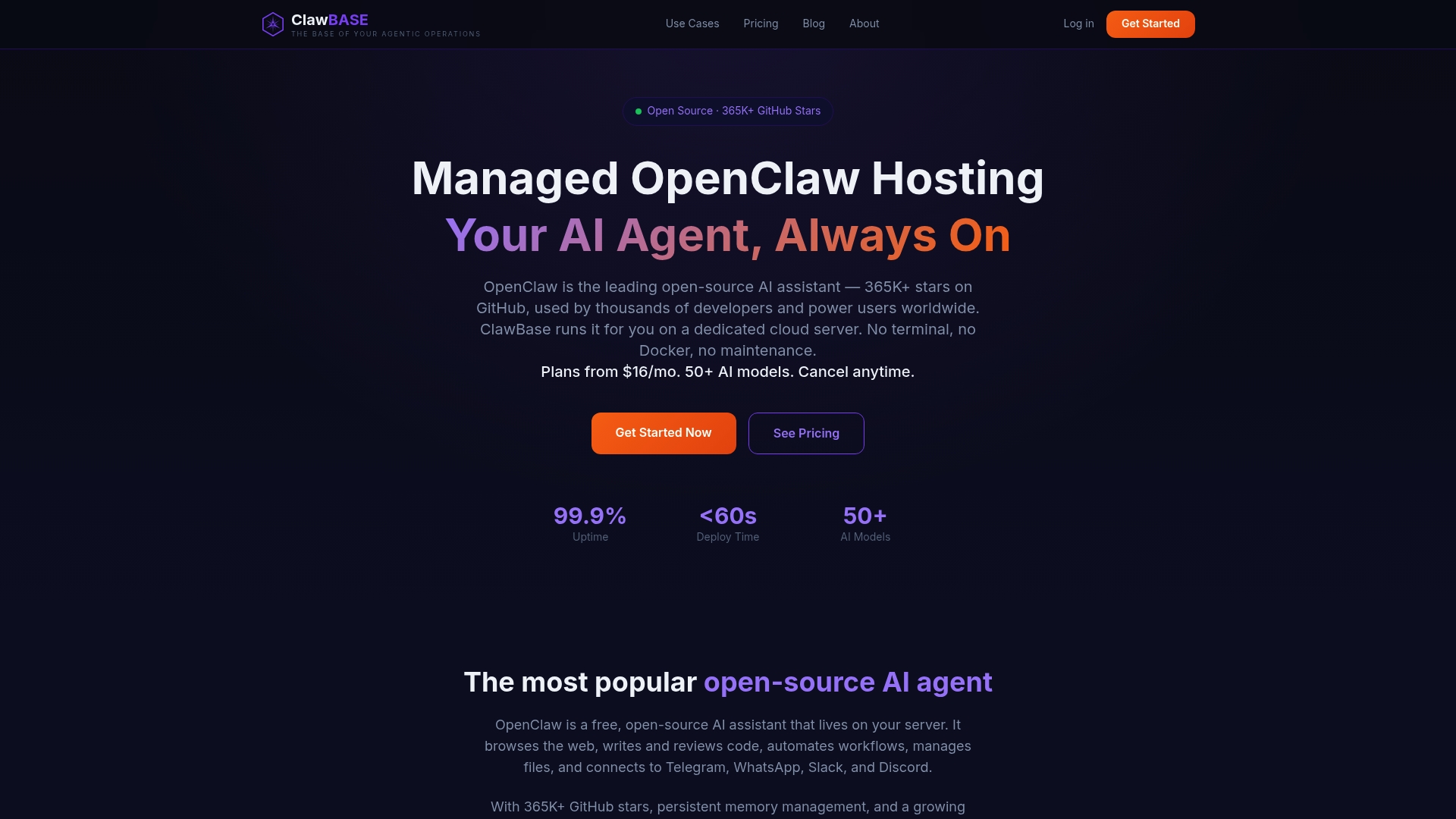
Clawbase runs on dedicated servers with 99.9% uptime and built-in monitoring, which means the anomaly detection and audit logging that most teams skip during a fast build are already in place. Non-technical professionals and developers alike get a private, always-on AI agent without the sysadmin overhead. Managed OpenClaw hosting starts at $16/mo and includes one-click deployment with no maintenance required. For teams that want to see what responsible AI automation looks like in practice, the Clawbase use cases page shows real workflow examples across file management, communication platforms, and process automation.
FAQ
What are the most common AI automation errors in professional settings?
The most common errors are automating undocumented workflows, granting AI agents excessive production access, and skipping output monitoring. These are process and governance failures, not model failures.
How do I prevent silent failures in AI automation?
Sample AI outputs daily and set automated alerts for workflow volume drops exceeding 30% day-over-day. Silent failures produce no error logs, so active monitoring is the only reliable detection method.
When should a human review AI automation output?
Human review is required at any output that is irreversible, customer-facing, or legally significant. Routing these outputs to a human checkpoint before execution prevents the most costly AI deployment mistakes.
What is adversarial review in AI workflows?
Adversarial review uses a secondary AI agent to challenge and find errors in the primary agent's output before it reaches production. It functions as an automated quality gate and catches mistakes the original agent misses.
How does the minimum access principle apply to AI agents?
Each AI agent should hold only the permissions needed for its specific task, scoped to the narrowest possible resource set. Destructive operations such as deletes and schema changes must require explicit human confirmation before execution.