Always-On AI Assistant Use Cases for Productivity in 2026
2026-07-11

An always-on AI assistant is a continuously operating AI agent that monitors data streams, executes tasks, and surfaces insights without waiting for a human prompt. Unlike traditional chatbots that respond only when queried, these persistent agents practice what Salesforce calls ambient intelligence: processing raw, continuous data flows to act proactively. The practical result is measurable. AWS Finance teams cut customer deep dive analysis from 6 hours to 10 minutes using region-specific agents. The always-on AI assistant use cases covered here span business analytics, software engineering, customer support, and personal productivity, giving you a concrete map of where these agents deliver the most value.
1. How always-on AI assistants transform business workflow automation
Business workflow automation is the most documented and highest-ROI category for persistent AI agents. The core mechanism is simple: an agent connects to structured databases, unstructured documents, and communication tools simultaneously, then acts on new information the moment it appears.
AWS Finance demonstrates the ceiling of this capability. Their region-specific agents automated weekly business reviews and reduced deep dive analysis from 6 hours to 10 minutes per customer. That time savings compounds across hundreds of accounts, reclaiming weeks of analyst capacity every quarter.

The same agents handle scenario modeling and risk assessment by querying millions of enterprise data rows in minutes. This shifts the analyst's role from data retrieval to interpretation, which is where human judgment actually adds value.
Key workflow tasks that always-on agents automate well:
- Weekly reporting and business review generation
- Target-setting and variance analysis across customer segments
- Risk flagging based on real-time data thresholds
- Cross-system data reconciliation between CRM and financial platforms
Pro Tip: *Customize your agents by business unit rather than deploying a single general-purpose agent. A finance agent trained on your chart of accounts and KPI definitions will surface far more relevant insights than a generic assistant.*
2. Software development and incident management
Software engineering teams lose significant time to context switching between monitoring dashboards, ticket queues, and communication tools. A persistent AI agent eliminates most of that friction by handling triage autonomously.
ThoughtSpot's AI-native software development lifecycle platform shows what this looks like at scale. Their specialized agent fleet reached 90.8% automated triage efficiency on engineering tasks. That figure means fewer than 1 in 10 incidents requires a human to perform initial classification.
The agents integrate directly into Slack and Jira, routing tickets and sending triage analysis to Slack threads before any engineer opens the incident. Engineers arrive at a problem with context already assembled, not a blank ticket.
Domain-specific agents in this environment handle:
- Code review queues, flagging style violations and potential bugs
- Performance regression detection across deployment pipelines
- Incident response coordination, including runbook suggestions
- On-call escalation routing based on severity and team availability
| Task | Without always-on agent | With always-on agent |
|---|---|---|
| Incident triage | Manual, 15–30 minutes | Automated, under 2 minutes |
| Code review routing | Developer assigns manually | Agent routes by domain expertise |
| Slack notification | Engineer monitors dashboards | Agent posts analysis proactively |
| Escalation decision | On-call judgment call | Agent scores severity, suggests path |
Pro Tip: *Embed your AI agent directly inside Slack or Microsoft Teams rather than requiring engineers to visit a separate tool. Adoption rates climb sharply when the agent lives where the team already works.*
3. Customer support and knowledge management
AI agents handle 24/7 Tier 1 customer support by autonomously querying knowledge bases and CRM records to resolve routine issues before escalation. The agent does not wait for a support ticket to be assigned. It reads the incoming request, matches it against known solutions, and either resolves it or routes it with full context attached.
The knowledge management application is equally powerful. AI assistants transform meetings and notes into searchable, structured intelligence that flows directly into CRM and project management systems. A conversation that previously lived in someone's notebook becomes a retrievable organizational asset within minutes of the meeting ending.
This continuous capture solves a real problem: institutional knowledge that walks out the door when employees leave. When an agent writes structured summaries into your knowledge base automatically, the organization retains context regardless of team turnover.
Core benefits in this category:
- Round-the-clock ticket resolution for common, repeatable issues
- Automatic meeting summaries pushed to Notion, Confluence, or your CRM
- Reduced manual data entry as agents write directly into operational systems
- Consistent response quality that does not vary by shift or agent experience
4. Personal productivity and daily task automation
Personal productivity is where always-on AI assistants become genuinely life-changing for individual users. The agent manages your calendar, triages your inbox, and handles scheduling without requiring you to touch a single menu.
AI-powered personal assistants organize bill payments, personal goals, and digital communications using natural language and voice commands. You describe what you need in plain English, and the agent executes across multiple tools simultaneously. That is the practical definition of an agentic workflow: one instruction, multi-tool execution.
The decision-support function is underrated. A persistent agent that monitors your project deadlines, meeting schedules, and email threads can surface a conflict or a missed follow-up before it becomes a problem. You get contextual alerts rather than reactive scrambles.
| Capability | Standard AI assistant | Always-on AI assistant |
|---|---|---|
| Email triage | On-demand, when you ask | Continuous, flags urgent items automatically |
| Calendar management | Manual input required | Schedules and reschedules based on priorities |
| Task reminders | Set manually | Generated from email and meeting context |
| Decision support | Answers questions asked | Proactively surfaces relevant information |
| Follow-up tracking | User must remember | Agent monitors and alerts automatically |
For users who want to schedule tasks with an AI assistant without writing a single line of code, the gap between capability and accessibility has narrowed considerably in 2026.
5. Financial analysis and scenario modeling
Finance teams represent one of the clearest always-on AI agent applications because the work is data-dense, time-sensitive, and highly repetitive. An agent that monitors financial data continuously can flag anomalies, generate variance reports, and model scenarios faster than any manual process.
The AWS Finance case establishes the benchmark: agents that query enterprise data at scale and produce analysis in minutes rather than hours. The underlying technique is embedding-based semantic search across structured financial records, which lets the agent find relevant data without requiring exact query syntax from the user.
Risk assessment is another strong fit. An always-on agent monitors incoming transactions, market signals, or customer payment behavior and flags threshold breaches in real time. The human analyst reviews flagged items rather than scanning everything, which is a fundamentally more efficient allocation of expertise.
6. Research and competitive intelligence monitoring
Persistent AI agents excel at monitoring tasks that require continuous attention but produce value only when something changes. Competitive intelligence is the clearest example. An agent can watch competitor websites, press releases, job postings, and industry publications around the clock, then surface a summary when something material shifts.
This is ambient intelligence applied to external data. The agent processes a continuous stream of web content and filters it against your defined criteria, delivering only what matters. A human researcher checking the same sources manually would need hours per week to replicate the coverage.
The same pattern applies to regulatory monitoring. An agent tracking regulatory body publications can alert your compliance team the moment a relevant rule change appears, giving you days of lead time that a weekly manual review would miss.
7. File management and cross-platform workflow integration
Always-on AI agents handle file organization, naming conventions, and cross-platform data movement as background tasks. You generate a document, and the agent classifies it, names it according to your schema, and routes it to the right folder or system automatically.
Clawbase's OpenClaw deployment supports integration with communication platforms like Telegram and Discord, which means the agent can receive instructions and return results through channels your team already uses. That integration pattern matters because it removes the friction of switching to a dedicated AI interface.
For teams managing large shared drives or document repositories, an agent that continuously applies consistent naming and tagging rules prevents the entropy that makes file systems unusable over time. The agent does not need to be asked. It acts on every new file as it arrives.
Key takeaways
Always-on AI assistants deliver the most value when they are embedded directly into existing workflows and given continuous access to live data rather than periodic snapshots.
| Point | Details |
|---|---|
| Ambient intelligence is the core mechanism | Persistent agents process continuous data streams, not one-off queries, enabling proactive action. |
| Business analytics shows the highest measured ROI | AWS Finance cut analysis time from 6 hours to 10 minutes using region-specific agents. |
| Engineering triage is nearly fully automatable | Specialized agent fleets reach over 90% automated triage efficiency on engineering tasks. |
| Personal productivity gains compound daily | Always-on agents handle email, scheduling, and follow-ups without waiting for user input. |
| Integration depth drives adoption | Agents embedded in Slack, Jira, or Telegram see higher use than standalone AI interfaces. |
What I actually think about always-on AI agents
Most articles treat always-on AI assistants as a feature upgrade. I think they represent a more fundamental shift: the move from AI as a tool you pick up to AI as a layer that runs underneath everything you do.
The reactive model, where you open a chat window and type a question, is still the dominant mental model for most users. That model undersells what persistent agents can actually do. The real value is not in answering questions faster. It is in eliminating the questions you should not have to ask in the first place because the agent already handled the underlying task.
What I have found in practice is that the biggest barrier is not technical. It is workflow design. Most users deploy an always-on agent and then interact with it exactly like a chatbot, which wastes most of its capability. The agents that deliver the most value are the ones given clear, bounded domains: this agent owns incident triage, this agent owns meeting notes, this agent owns email routing. Overlap creates confusion; specialization creates reliability.
The human control question is real, and I do not dismiss it. An agent that acts proactively needs well-defined guardrails. The answer is not to limit the agent's autonomy arbitrarily. The answer is to define escalation criteria clearly so the agent knows exactly when to act and when to ask. That design work is where most of the implementation effort should go, and most teams skip it entirely.
> *— Iosif Peterfi*
Clawbase: a practical starting point for always-on AI deployment
Deploying a persistent AI agent used to require significant server administration expertise. Clawbase removes that barrier with one-click deployment of OpenClaw on a dedicated server, starting at $16/mo, with no maintenance required on your end.
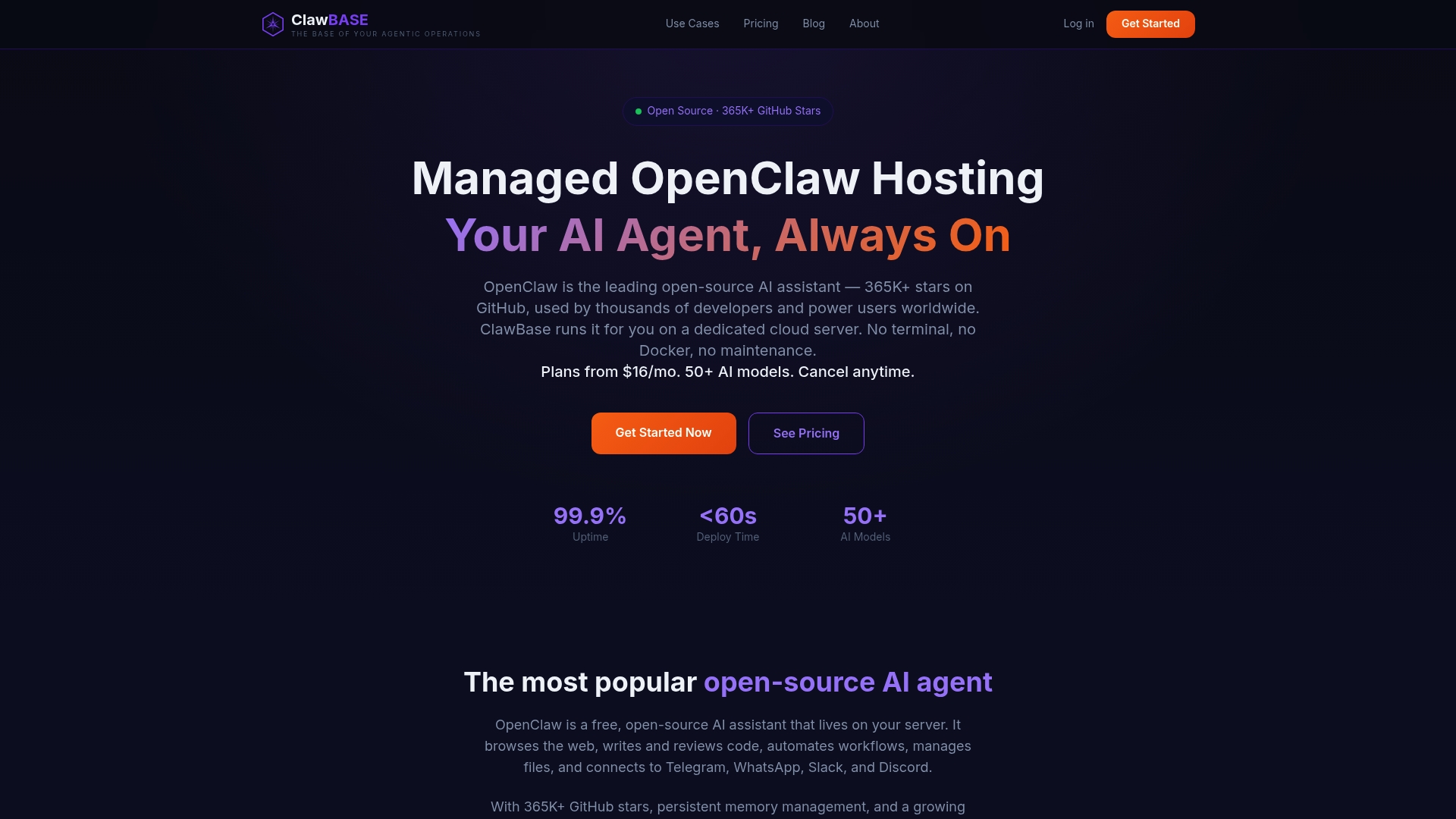
Clawbase gives you a private, always-on AI agent with 99.9% uptime, persistent memory management, and access to over 50 AI models. The agent integrates with Telegram and Discord out of the box, so you can route instructions and receive results through tools you already use. For users who want to set up an AI assistant without writing code, Clawbase handles the infrastructure entirely. You can review the full range of OpenClaw use cases to match the agent's capabilities to your specific workflow before committing.
FAQ
What does always-on AI mean?
Always-on AI refers to an AI agent that operates continuously, processing live data streams and executing tasks without waiting for a user prompt. The defining characteristic is proactive action rather than reactive response.
What are the main benefits of an always-on AI agent?
The primary benefits are time savings through automation, continuous monitoring without human attention, and proactive task execution. AWS Finance documented a reduction from 6 hours to 10 minutes per customer analysis as one concrete example.
How do always-on AI assistants differ from standard chatbots?
Standard chatbots respond only when queried and have no persistent state between sessions. Always-on AI assistants maintain continuous context, monitor live data, and act on triggers without requiring a human to initiate the interaction.
What are the best use cases for a persistent AI assistant?
The highest-value use cases are business analytics and reporting, software engineering triage, 24/7 customer support, meeting intelligence, and personal schedule management. Engineering platforms have documented over 90% automated triage efficiency using specialized agent fleets.
Can non-technical users deploy an always-on AI assistant?
Yes. Managed hosting platforms handle server setup, uptime, and maintenance automatically. Clawbase, for example, offers one-click OpenClaw deployment starting at $16/mo with no coding or server administration required.