AI Backend Abstraction Explained for Developers
2026-07-06

AI backend abstraction is defined as a server-side architectural layer that decouples application business logic from specific AI model providers through unified API standards. This layer standardizes access to chat completions, embeddings, vector stores, and tool calling across providers like OpenAI and AWS Bedrock, so your application never speaks directly to a model vendor. The practical result: you can swap providers without rewriting core logic. For developers integrating AI into production systems, understanding what is AI backend abstraction is the difference between a brittle integration and a maintainable architecture. Abstraction here is not just a convenience layer. It is a discipline of dependency management.
What is AI backend abstraction, and why does it matter?
AI backend abstraction reduces vendor lock-in by up to 90% by standardizing how your application calls AI services. That figure reflects a real architectural shift: when your code targets a unified interface rather than a specific provider SDK, switching from one model to another requires no changes to your business logic. The abstraction layer handles translation, routing, and error normalization behind the scenes.
The industry term for this concept is the *AI backend abstraction layer*, sometimes called a model gateway or AI infrastructure layer. All three phrases describe the same architectural contract: your application calls one interface, and the layer decides which provider, model, or fallback path fulfills the request. This is the same principle behind the Repository pattern in traditional software design, applied to AI infrastructure.

The growing adoption of multi-model workflows makes this discipline non-negotiable. A production AI system today may route a summarization task to one model, an embedding task to another, and a vision task to a third. Without an abstraction layer, each of those integrations lives in your application code, creating a maintenance burden that compounds with every new provider you add.
What are the core components of an AI backend abstraction layer?
A production-grade abstraction layer does far more than proxy API calls. The core components that separate a real abstraction layer from a simple wrapper include:
- Unified API endpoints: A single interface covering chat completions, embeddings, tool calling, and vector store operations. Your application sends one request format regardless of the underlying provider.
- Policy-driven model orchestration: Routing logic that selects a model based on cost, latency, or reliability thresholds. This is not static configuration. It responds to live conditions.
- Centralized cost monitoring and observability: Token usage, latency metrics, and error rates flow through one pipeline. You get a single dashboard instead of fragmented provider consoles.
- Automated operational guardrails: Rate limit handling, retry logic, and failure fallback run at the layer level. Your application code never needs to handle provider-specific error codes.
- Pre-built infrastructure blocks: Frameworks like AWS Blocks offer roughly 20 pre-built components covering retrieval-augmented generation (RAG), persistent memory, and agentic orchestration. These reduce development time from weeks to days.
Pro Tip: *Treat your abstraction layer as a first-class service, not a utility script. Give it its own test suite, versioned interface contract, and deployment pipeline. This discipline pays off the first time you need to swap a provider under production load.*
The distinction between a simple API proxy and a true abstraction layer is operational maturity. A proxy forwards requests. An abstraction layer enforces policy, manages state, and provides observability. If your current setup lacks cost monitoring and automated fallback, it is a proxy, not an abstraction layer.
How do different AI backend abstraction strategies compare?
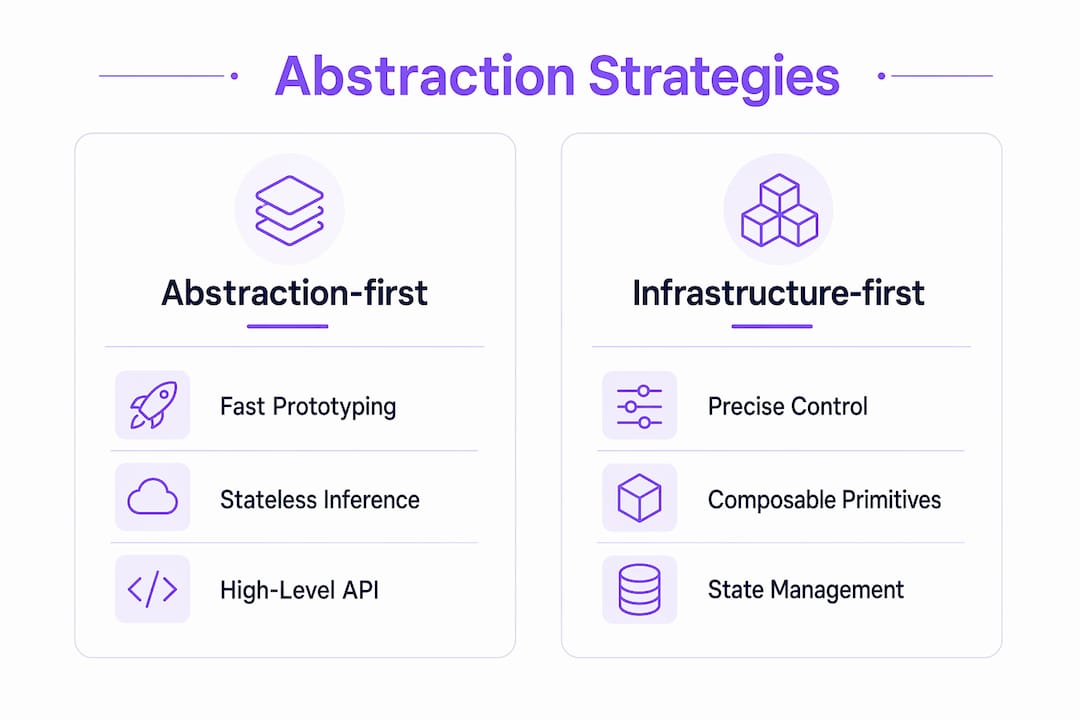
Developers choosing an abstraction strategy face a fundamental trade-off between speed and control. The two dominant approaches are abstraction-first platforms and infrastructure-first platforms, and each serves a different workload profile.
| Strategy | Best for | Trade-off |
|---|---|---|
| Abstraction-first platform | Stateless inference, fast prototyping | Limited stateful feature support |
| Infrastructure-first platform | Persistent memory, multi-component orchestration | Higher setup cost and complexity |
| Layered N-tier architecture | Balanced control and maintainability | Requires strict directionality discipline |
Abstraction-first platforms prioritize developer speed. They expose a clean, high-level API and handle provider routing internally. The cost is flexibility: stateful AI applications often require persistent memory and orchestration that these platforms handle poorly without external services bolted on.
Infrastructure-first platforms expose composable primitives for compute, storage, and networking. You get precise control over state management and predictable performance. The trade-off is a steeper setup curve and more code to maintain.
Layered N-tier architecture sits between these extremes. It enforces a directionality constraint: higher layers call lower layers, never the reverse. Strict layered architectures keep business logic unaffected by lower-level provider changes, which is the core promise of any abstraction strategy.
Pro Tip: *Start with an abstraction-first platform for proof-of-concept work, then migrate critical stateful workflows to an infrastructure-first layer once your data and memory requirements are clear. Mixing strategies is valid. Mixing them without clear boundaries is not.*
What design patterns make AI backend abstraction effective?
The Repository and Gateway patterns are the two most reliable tools for building clean abstraction boundaries. The Repository pattern creates a contract between your domain logic and external AI services, isolating implementation details behind a defined interface. Your business logic calls getEmbedding(text), not openai.embeddings.create(...). The provider is invisible to the caller.
The Gateway pattern extends this by handling cross-cutting concerns: authentication, rate limiting, logging, and fallback routing. Together, these patterns let you test your business logic without live AI connectivity. You mock the interface, not the provider SDK. That distinction matters enormously in CI/CD pipelines where live API calls add cost and latency.
Key principles for maintaining effective abstraction:
- Define explicit interface contracts. Every method your application calls on the abstraction layer must have a documented signature and behavior contract. Undocumented methods become leaky abstractions.
- Use dependency injection. Pass the abstraction interface into your services rather than instantiating providers directly. This keeps your code testable and provider-agnostic.
- Enforce directionality. Business logic calls the abstraction layer. The abstraction layer calls providers. Providers never call back into business logic. Violating this creates circular dependencies that are hard to debug and harder to refactor.
- Avoid over-abstraction. Abstraction is a discipline, not a pattern. Wrapping every provider call in three layers of interfaces adds complexity without adding value. Abstract at the boundary where provider details would otherwise leak into your domain.
The test for a healthy abstraction is simple: can you replace the underlying provider without touching a single line of business logic? If the answer is no, the abstraction layer is leaking.
What are the real benefits and challenges of AI backend abstraction?
The benefits of backend abstraction are concrete and measurable. Standardization across chat completions, embeddings, and tool calling enables provider swapping in over 90% of standard inference workflows without code changes. That is not a theoretical benefit. It is the difference between a two-hour provider migration and a two-week refactor.
The practical gains include:
- Faster infrastructure setup: Pre-built blocks and primitives for common AI workflows accelerate deployment and remove the need to rebuild RAG pipelines or memory management from scratch.
- Governance by design: Centralized model-aware gateways enforce token budgets, policy routing, and access controls. This prevents unauthorized model use and gives compliance teams a single audit point.
- Reduced switching costs: When a provider raises prices or degrades performance, you route traffic elsewhere at the gateway level. Your application code stays unchanged.
The challenges are equally real. Statefulness is the hardest problem. Most abstraction-first platforms handle stateless inference well and handle persistent memory poorly. Multi-component orchestration, where an agent calls tools, stores results, and resumes a workflow, requires infrastructure that many lightweight gateways simply do not provide.
Governance also cuts both ways. Centralizing AI access through a model-aware gateway prevents shadow AI use across your organization. That is a security benefit. It also means the gateway becomes a critical path dependency. If it fails, every AI-dependent service fails with it. Design for that failure mode from day one.
How are modern AI backend frameworks shaping abstraction in 2026?
The frameworks leading AI backend abstraction in 2026 share a common design philosophy: composable APIs that handle orchestration, memory, and routing without requiring you to build those primitives yourself.
Continuum provides composable APIs with multi-agent patterns, durable execution, and stateful memory with privacy by design. It supports cost-aware multi-model inference and open tool calling, which means your agents can call external tools through a standardized interface regardless of which model is running the task.
AgenticAPI and Continuum both provide automatic fallback and cost-aware inference routing behind unified APIs. Smart routing selects the lowest-cost model that meets your latency threshold, then falls back to a secondary provider if the primary is unavailable. You get multi-model AI support without writing routing logic yourself.
The practical impact of these frameworks is significant. Developers building AI agent architectures no longer need to wire together memory stores, orchestration engines, and provider SDKs manually. The framework exposes one API surface. Your application code stays clean. The framework handles the complexity of multi-provider, multi-model, stateful execution underneath.
Key Takeaways
AI backend abstraction is the architectural discipline that keeps your application logic independent of AI provider changes, enabling provider swaps, governance, and orchestration without touching business code.
| Point | Details |
|---|---|
| Core definition | An abstraction layer standardizes AI provider access through unified APIs, covering completions, embeddings, and tool calling. |
| Vendor lock-in reduction | Standardization enables provider swapping in over 90% of standard inference workflows without code changes. |
| Design pattern discipline | Repository and Gateway patterns create testable, provider-agnostic contracts between business logic and AI infrastructure. |
| Stateful workloads need infrastructure-first | Persistent memory and multi-agent orchestration require infrastructure-first platforms, not lightweight abstraction proxies. |
| Governance is a structural benefit | Centralized model-aware gateways enforce token budgets, access policies, and compliance controls at the architecture level. |
Why abstraction discipline separates good AI systems from fragile ones
I have seen developers treat abstraction as a checkbox. They wrap an OpenAI call in a function, call it an abstraction layer, and move on. Six months later, when the provider changes its SDK or raises prices, they discover the abstraction was an illusion. The provider's types, error codes, and response shapes had leaked into a dozen places across the codebase.
The discipline I keep coming back to is contract definition. Before writing a single line of provider integration code, define the interface your application will call. What does generateText return? What does getEmbedding accept? Write those contracts first, then implement them against the provider. That order matters. When you write the provider integration first, the provider's design shapes your interface. When you write the interface first, your domain shapes the integration.
The other pattern I watch for is over-abstraction. Teams that have been burned by vendor lock-in sometimes build abstraction layers so thick that the layer itself becomes the maintenance burden. Every new provider feature requires an interface update, a new adapter, and a new test suite. The abstraction that was supposed to reduce complexity has become a second system to maintain.
The right balance is to abstract at the boundary where provider details would genuinely harm your domain logic if they leaked. Chat completions, embeddings, and tool calling are the right level. The specific retry behavior of a single provider's SDK is not. Abstract the former. Let the latter live inside the adapter.
Multi-model orchestration and governance layers are where I see the most growth in 2026. The teams building serious AI products are not asking "which model should we use?" They are building routing layers that answer that question dynamically, based on cost, latency, and task type. That is the future of AI backend architecture, and it only works if your abstraction layer was designed for it from the start.
> *— Iosif Peterfi*
Clawbase makes AI backend hosting production-ready
Building a clean abstraction layer is hard enough without also managing server infrastructure, uptime, and model access. Clawbase handles the infrastructure side so you can focus on the architecture.
Clawbase provides managed OpenClaw hosting starting at $16/mo, with one-click deployment on a dedicated server, 99.9% uptime, and access to over 50 AI models. Persistent memory management and agentic workflow support are built in, which means the stateful orchestration challenges covered in this article are handled at the platform level. Developers get a private, always-on AI agent that integrates with Telegram, Discord, and custom workflows. Explore the full range of AI agent use cases Clawbase supports to see where it fits your stack.
FAQ
What is AI backend abstraction in simple terms?
AI backend abstraction is a server-side layer that gives your application one consistent interface to call AI services, regardless of which provider or model runs underneath. It decouples your business logic from provider-specific SDKs and APIs.
How does an AI abstraction layer reduce vendor lock-in?
By standardizing chat completions, embeddings, and tool calling behind a unified API, an abstraction layer enables provider swapping in over 90% of standard inference workflows without changing application code.
What is the difference between an abstraction-first and infrastructure-first AI platform?
Abstraction-first platforms prioritize fast deployment and stateless inference but handle persistent memory poorly. Infrastructure-first platforms expose composable primitives for precise state management and multi-component orchestration at the cost of higher setup complexity.
Which design patterns work best for AI backend abstraction?
The Repository and Gateway patterns are the most effective. They create explicit contracts between domain logic and AI providers, support testability without live API connectivity, and isolate your business logic from provider SDK changes.
What are the main benefits of backend abstraction for production AI systems?
The primary benefits are reduced vendor lock-in, centralized governance and cost controls, faster deployment through pre-built infrastructure blocks, and the ability to route traffic across multiple providers based on cost and latency.